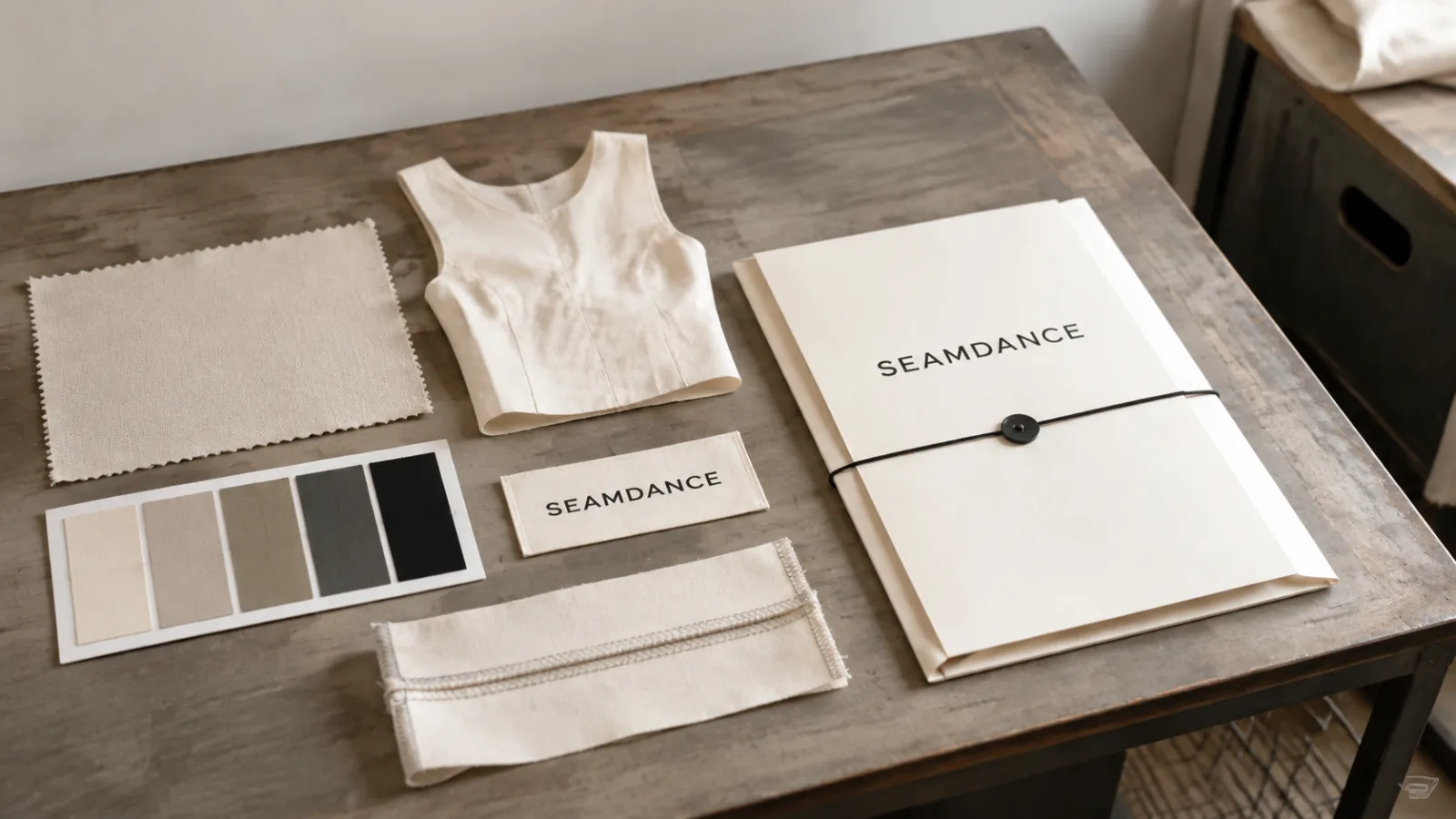
Almost every bulk disaster is a missing approval wearing a disguise. Five decisions, closed in the right order and documented, make production boring — which is the goal. Here is the checklist and how each approval is evidenced.
Approvals one and two: material and fit
Material approval means the actual production fabric — composition, weight, hand feel, stretch and recovery, tested and signed, with a fabric swatch retained by both sides. Approving “equivalent” fabric from a photo is where substitution disasters are born.
Fit approval means measurements and movement behavior confirmed on a body against the graded spec — squat opacity, waistband hold, bra support behavior on film. After fit locks, fit variables freeze: later 'small tweaks' reopen the block and reset the clock.
Approvals three and four: color and branding
Color approval runs on physical lab dips under agreed lighting (daylight plus store lighting is the practical pair), against a physical standard — never a screen. Approve per fabric base: the same dye reads differently on different knits.
Branding approval covers logo method and placement, labels, hangtags and packaging artwork — with a physical strike-off or embroidery sew-out. Legal details live here too: fiber content wording, care symbols, country of origin. Cheap to fix now, expensive on 3,000 sewn labels.
Approval five: the sealed sample
The pre-production sample in final fabric, final color, final trims — signed and physically sealed, one copy with the buyer, one in the facility — is the workmanship standard. From this point, 'good enough' has a definition: matches the sealed sample or it does not.
This is the document that makes inspection objective: at SEAMDANCE, AQL 2.5 final inspection measures bulk against the sealed reference and graded spec — not against anyone's memory of what was agreed.
Run it as a gate, not a vibe
Each approval closes with an artifact: signed swatch card, fit-approval sheet with filmed tests, approved lab dips, branding strike-offs, sealed samples. Five artifacts, then bulk. Any gap is a risk you are choosing.
The discipline pays twice: production runs without 'quick questions', and reorders become trivial — the standard exists, so repeat programs go straight to fabric booking. That is how a 98% on-time network record is maintained: boring, gated production.
Quick answers
What if a change is truly needed after sealing?
Re-open formally: document the change, re-approve the affected artifact, re-seal. It costs days. Informal 'just change it' costs the standard itself — after that, inspection has no anchor.
Who keeps the sealed samples?
Minimum two: buyer holds one, the production facility holds one, and the QC team references it at inspection. For multi-facility programs, the coordinating partner holds the master set.
Sourcing styles for your line? The 2026 catalogue lists every ready-to-develop style — colorways, materials, quote list built in.