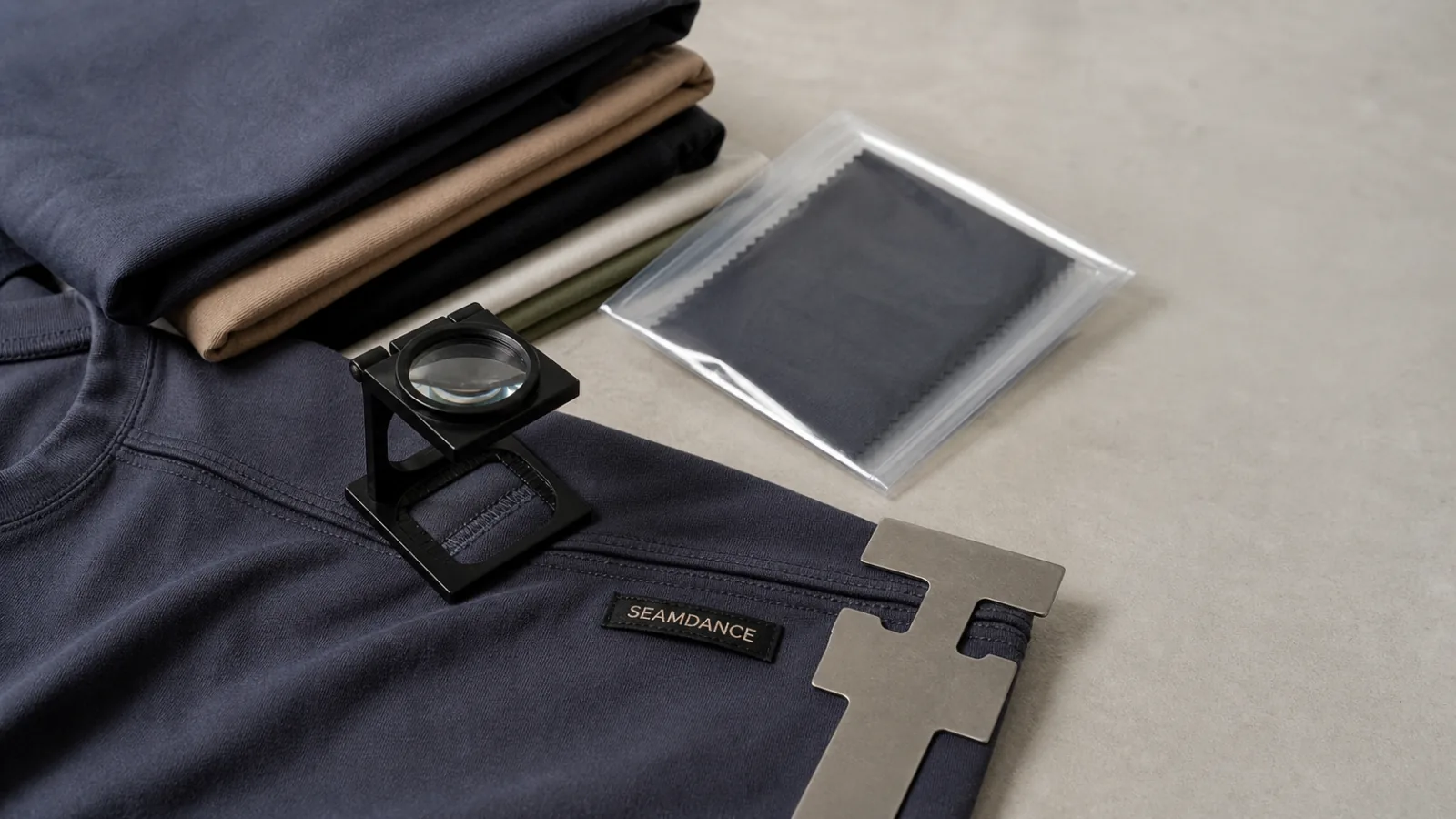
“Inspection to AQL 2.5” appears in every apparel contract, and few buyers could say what it promises. It is worth five minutes: the number defines how much risk you are accepting, and what you can reject.
The short answer
- AQL 2.5 is a lot-acceptance rule, not a per-garment promise. A random sample is drawn from the finished lot, defects are counted by class, and the whole lot is accepted or rejected against a published limit.
- The 2.5 applies to major defects. Critical defects — anything unsafe or unlawful, such as wrong fibre content or a missing care label — carry a zero tolerance, and minor defects are usually judged against a looser limit, commonly 4.0.
- In statistical terms the AQL is "a percent defective that is the base line requirement for the quality of the producer's product" [1]. A plan is written as n (sample size) and c (acceptance number): the lot is rejected if more than c defectives appear in the sample [1].
- Two risks are built in and cannot be removed, only priced: the producer's risk of rejecting a lot that is actually at the AQL, and the consumer's risk of accepting a lot at the level the buyer would refuse [1].
The idea: statistical sampling
Inspecting every garment of a 5,000-piece order is slow and destructive (bags opened, garments handled). AQL — Acceptable Quality Limit — solves this with statistics: inspect a defined random sample, count defects by class, accept or reject the lot against published thresholds from the sampling tables.
The system's honesty is that it is explicit about risk: AQL 2.5 roughly means the process should not ship lots running worse than 2.5 major defects per hundred units. It is a lot-acceptance standard, not a promise that every unit is perfect.
The vocabulary is worth getting right, because contracts are argued in it. Acceptance sampling is the middle path between no inspection and inspecting every piece: "a sample should be picked at random from the lot, and on the basis of information that was yielded by the sample, a decision should be made regarding the disposition of the lot" [2]. Everything else — sample size, acceptance number, the two risks — is the arithmetic of that one sentence.
The terms every sampling plan is written in
| Term | What it means | Why a buyer should care |
|---|---|---|
| n | Sample size — how many pieces are drawn at random from the lot [1] | Bigger lots take bigger samples; it does not scale one-for-one, which is why large orders are not proportionally more expensive to inspect |
| c | Acceptance number — the lot is rejected if more than c defectives are found [1] | This is the number your contract is really setting when it names an AQL |
| AQL | "A percent defective that is the base line requirement for the quality of the producer's product" [1] | The quality level the plan is designed to accept most of the time, not the quality level you will receive |
| LTPD | "A designated high defect level that would be unacceptable to the consumer" [1] | The level the plan is designed to catch — useful when you want to argue about how bad is bad |
| Producer's risk | The probability of rejecting a lot that is genuinely at the AQL [1] | Good lots occasionally fail. Build a re-inspection route rather than treating a fail as proof of bad faith |
| Consumer's risk | The probability of accepting a lot that is genuinely at the LTPD [1] | Bad lots occasionally pass. This is why sampling is paired with sealed samples and in-line checks, not used alone |
Defect classes decide the outcome
Defects are classed before counting: critical (safety or legal — broken needles, wrong fiber content) where the tolerance is zero; major (would cause a return — holes, broken stitching, visible stains, out-of-tolerance measurements, wrong color) counted against the 2.5 line; minor (unlikely to cause a return — a loose thread, slightly uneven topstitch) counted against a looser line, commonly 4.0.
The classification list matters as much as the number. A well-run program agrees the defect list per product in advance — waistband hold failure is a major for leggings, not a matter of taste.
Critical is the class that most buyers under-specify, because it is the one with a legal edge. In the United States, fibre content must be disclosed with the generic names the Commission has established [3], and care information must be permanent, legible for the useful life of the product, and supported: the rule makes it a violation "To fail to possess, prior to sale, a reasonable basis for all regular care information disclosed to the purchaser" [4]. The five care symbols used in Europe are licensed trademarks recognised by the ISO 3758 standard and "may not be reproduced, issued or used without a special license agreement" [5]. A carton of leggings with the wrong fibre percentage on the label is not a cosmetic problem — it is unsellable.
Defect classes, and the line each is judged against
| Class | Definition used on our inspections | Activewear examples | Limit we run |
|---|---|---|---|
| Critical | Unsafe, or unlawful to sell as labelled | Broken needle in the garment; fibre content that does not match the label [3]; missing or unsupported care instructions [4]; unlicensed care symbols [5] | Zero — one finding fails the lot |
| Major | Would reasonably cause a return or a markdown | Holes, broken or skipped stitching, visible stains, measurements outside the graded tolerance, wrong colourway | AQL 2.5 |
| Minor | Noticeable but unlikely to cause a return | A loose thread end, slightly uneven topstitch, minor label placement drift | AQL 4.0 |
What inspection needs to work
Random sampling across the whole lot and all sizes/colors — not the cartons nearest the door. Measurement checks against the graded spec. And a standard to compare workmanship against: the sealed sample. Without it, 'defect' becomes a debate.
Who inspects matters too: a factory self-inspecting marks its own homework. At SEAMDANCE, final inspection is performed by our own QC team in every partner facility, to AQL 2.5, against the sealed reference — the same standard in every factory is precisely the point of a managed network.
Measurement checks need a method, not an opinion. Stretch and recovery on the knits activewear is built from are measured to published test methods — ASTM D2594 for knitted fabrics of low power [6], ASTM D3107 for woven stretch [7] — and colourfastness, dimensional change and pilling are judged against AATCC methods, which the association describes as "international standards cited in government, industry, and individual company specifications worldwide" [8]. Naming the method in the tech pack is what turns "the fabric went baggy" into a measurable, arguable claim.
Using the result
A passed inspection releases shipment. A failed one triggers the agreed remedy: sorting, rework, re-inspection — agreed before production, when you had leverage. Keep inspection reports; over time they are supplier scorecards, and they are the evidence if a claim ever escalates.
Buyers can layer more: in-line inspections mid-production catch drift early, and third-party spot audits keep everyone honest. For most programs, staged approvals plus a real AQL 2.5 final is the efficient backbone.
What happens after the inspection, and when to agree it
| Result | What it means | What should already be agreed |
|---|---|---|
| Pass | The lot is released for shipment | Who signs off, and how the report reaches you |
| Fail — sort | Every piece is checked and defectives pulled | Who pays for sorting, and the re-inspection standard |
| Fail — rework | Defects are repaired and the lot re-presented | Maximum rework rounds, and the effect on the ship date |
| Fail — reject | The lot is not accepted | Remedy, liability and replacement timing, agreed before production |
Quick answers
Is AQL 2.5 strict enough for premium activewear?
It is the standard level for quality apparel and appropriate for most programs. Some brands tighten specific classes — measurements to AQL 1.5, criticals always zero — rather than tightening everything, which raises cost without proportional benefit.
Does passing AQL mean zero defective pieces reach customers?
No — it bounds the defect rate statistically. Combined with sealed standards and in-line checks, it keeps defect exposure at a level returns data will confirm as low.
Who should perform the final inspection?
Not the factory alone. A factory inspecting its own output is marking its own homework, and the sampling maths assumes an independent draw. On SEAMDANCE programs the final inspection is performed by our own QC team inside the partner facility, to the same standard in every facility, against the sealed reference sample.
What does AQL 2.5 not cover?
Anything you did not define. Sampling counts defects against a list; if the list does not say that waistband roll-down is a major defect for your legging, it will not be counted as one. The defect list, the graded measurement chart and the sealed sample are agreed before production, not argued after it.
Can a lot pass inspection and still contain defective garments?
Yes, and the standard says so openly. Sampling bounds the defect rate statistically; it carries a consumer's risk of accepting a lot at a level you would refuse [1]. That is why AQL is paired with in-line checks during production and a sealed reference, rather than used as the only control.
Sources
- NIST/SEMATECH e-Handbook of Statistical Methods, 6.2.2 Single sampling plans for attributes — definitions of n, c, AQL, LTPD, producer's and consumer's risk
- NIST/SEMATECH e-Handbook of Statistical Methods, 6.2 What is acceptance sampling?
- 16 CFR Part 303 — Rules and Regulations Under the Textile Fiber Products Identification Act (eCFR)
- 16 CFR Part 423 — Care Labeling of Textile Wearing Apparel and Certain Piece Goods (eCFR)
- GINETEX — Care labelling: basic principles, and the licensing of the five care symbols
- ASTM D2594 — Standard Test Method for Stretch Properties of Knitted Fabrics Having Low Power
- ASTM D3107 — Standard Test Methods for Stretch Properties of Fabrics Woven from Stretch Yarns
- AATCC — Testing & Standards: test methods for textile evaluation
Sourcing styles for your line? The 2026 catalogue lists every ready-to-develop style — colorways, materials, quote list built in.