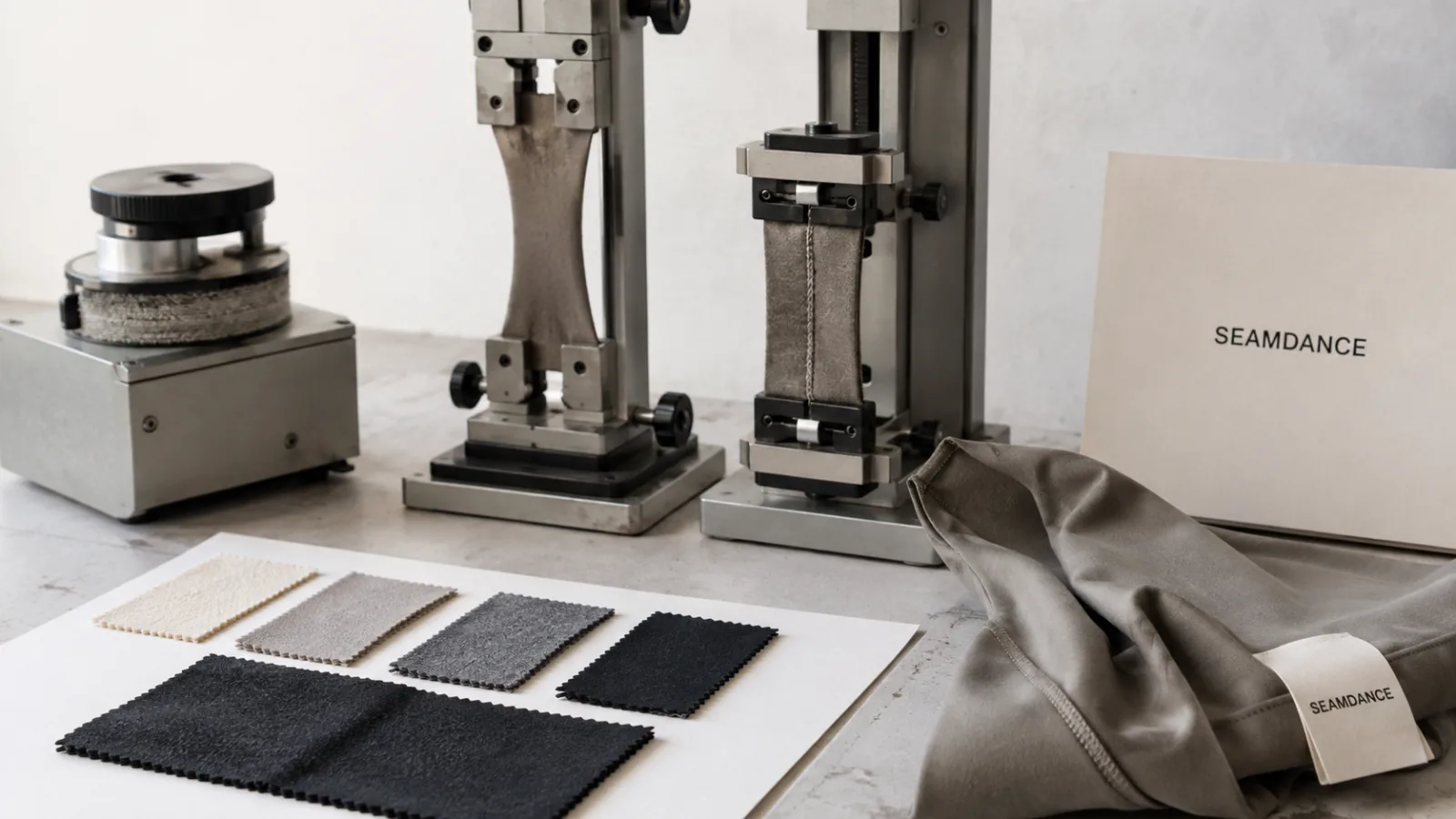
Testing feels like bureaucracy until the first batch of black leggings turns a customer's white sofa grey. Each standard test exists because someone shipped the failure it screens for. Here is the menu, translated, with a sensible minimum panel.
Colorfastness: the reputation tests
Colorfastness to washing (does the color survive laundry), to rubbing/crocking (does color transfer dry or wet — the sofa test), to perspiration (sweat plus dye chemistry) and to light for outdoor-worn pieces. Deep shades on high-spandex knits are the risk zone, black and burgundy especially.
These are cheap, fast lab tests graded on simple scales. Specify minimum grades in the fabric approval, and re-test when a dye house or a recipe changes — not just once at development.
Mechanical durability
Pilling resistance (Martindale or ICI box) for brushed and soft-hand surfaces; bursting or seam strength where stretch garments are stressed (gusset joins, bra band anchors); abrasion where straps and bags rub. Snagging tests matter for open-structure and seamless jacquard fabrics.
Garment-level checks complement fabric tests: seam slippage and stitch security on flatlock joins under stretch — a seam that survives being sewn is not automatically a seam that survives a squat.
Dimensional stability and appearance after wash
Shrinkage testing (dimensional change after standard wash cycles) protects your size chart: a legging that shrinks 5% in length has quietly changed size. Appearance-after-wash catches twisting legs, waving hems and surface change.
For stretch garments, add recovery-after-wash — covered in our stretch and recovery guide — because spandex ages with heat and detergent. Wash tests are the cheapest simulation of your customer's first month.
A sensible minimum panel
For a typical legging program: colorfastness to wash and rub, pilling on brushed faces, stretch and growth (washed), shrinkage, plus fiber-content verification for the label. Bras add strap and band strength; swim adds chlorine and seawater fastness; kids' products add regulatory chemical testing per destination market.
At SEAMDANCE, the test panel is agreed at material approval and reports are filed with the program documents — so claims on your labels, from fiber content to care instructions, trace to a report rather than a hope. Chemical-safety coverage (e.g. OEKO-TEX®) rides with the certified partner mills we match per project.
The tests, the standards, and when to require them
| What it checks | Common standards | When to require it |
|---|---|---|
| Fibre composition | ISO 1833 (quantitative chemical analysis) | Any label claim; always on blends, where drift is common |
| Colour fastness to washing | ISO 105-C06 · AATCC 61 | Every programme — the baseline colour test |
| Colour fastness to rubbing (crocking) | ISO 105-X12 · AATCC 8 | Deep shades and prints, especially on light under-layers |
| Colour fastness to perspiration | ISO 105-E04 · AATCC 15 | Anything worn against skin during sweat — i.e. activewear |
| Dimensional stability to washing | ISO 5077 with ISO 6330 · AATCC 135 | First production of any new fabric; again after mill changes |
| Pilling resistance | ISO 12945 (Martindale) · ASTM D3512 | Brushed and soft-hand fabrics; contact-panel areas |
| Bursting strength (knits) | ISO 13938 · ASTM D3786 | Compression styles and anything with high stretch load |
| Seam strength / slippage | ISO 13935 · ASTM D1683 | First production of a new construction or new factory |
| Stretch and recovery | ASTM D2594 (knitted stretch fabrics) | Leggings and compression — spec it after wash cycles, not only new |
| Flammability (US apparel) | 16 CFR Part 1610 | US-bound goods; note exemption logic covered in the spandex guide |
| Restricted substances — azo dyes | ISO 14362 | EU-bound goods and any RSL programme |
| Formaldehyde | ISO 14184-1 | Resin-finished or wrinkle-treated fabrics; many retail RSLs |
| pH of aqueous extract | ISO 3071 | Skin-contact textiles; a cheap early-warning test |
Quick answers
Who pays for testing?
Practice varies: standard mill tests often come with the fabric; program-specific panels are usually a modest buyer cost folded into development. Either way, insist on seeing actual reports with lab names and dates.
How often should tests repeat?
At development, at any change of mill, dye house or recipe, and periodically on long-running programs — annually is a common rhythm, plus per-lot color checks on sensitive shades.
Sources
Sourcing styles for your line? The 2026 catalogue lists every ready-to-develop style — colorways, materials, quote list built in.