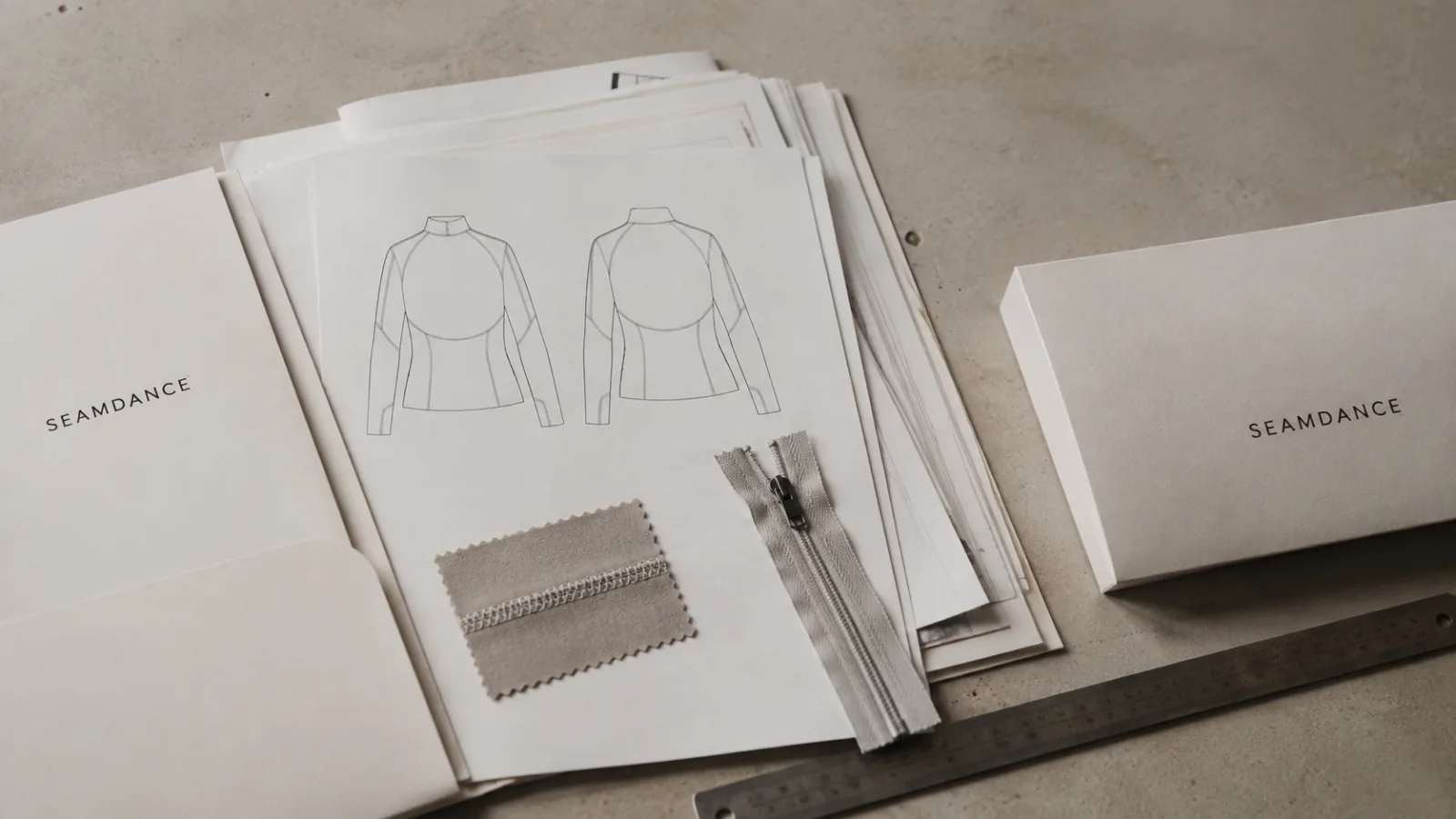
A tech pack is not a test you must pass to deserve a factory — it is a communication tool. Complete ones speed sampling; wrong ones are worse than none, because they get executed. Here is what actually needs to be in it, and what a good partner fills in.
The short answer
- A usable activewear tech pack is four things: a graded measurement chart with tolerances, a bill of materials naming fabric and every trim, construction and stitch detail at the seams that carry load, and the label and packaging pack.
- Two of those four are legal documents in disguise. In the United States, fibre content must be disclosed using the generic names the Commission has established [1], and you must hold a reasonable basis for the care instructions before the item is sold [2]. In Europe, the five care symbols are licensed trademarks recognised by the ISO 3758 standard and "may not be reproduced, issued or used without a special license agreement" [3].
- Where a requirement is a performance claim — four-way stretch, recovery, colourfastness — name the test method, not the adjective. Stretch on knits is measured to ASTM D2594 [4], on wovens to ASTM D3107 [5], and AATCC methods are "international standards cited in government, industry, and individual company specifications worldwide" [6].
- You do not need a complete tech pack to start. A reference garment, a target customer and a quantity are enough for a first quotation; the tech pack is an output of development as often as it is an input.
The non-negotiable core
Five things make a tech pack usable: flat sketches (front/back) with construction callouts; a measurement chart with tolerance for the base size; fabric intent (composition, weight range, hand feel reference); trim and branding details (logo method, placement, labels); and the intended end use with support or compression level.
Grading rules, seam allowances and stitch specifications are valuable if you have them — but a competent development partner derives them from the core. State what you know; flag what you assume.
The four blocks a factory actually needs
| Block | What it must contain | What goes wrong without it |
|---|---|---|
| Graded measurements | Point-of-measure list, base size, grade rules, and a tolerance per point | Every sample is argued instead of measured; nothing can be inspected against a spec |
| Bill of materials | Fabric construction and weight, fibre split, every trim by supplier reference, thread and elastic | Substitutions happen silently and the fibre content on your label stops being true [1] |
| Construction detail | Stitch type and seam class at the load-bearing seams, topstitch spacing, elastic application | The sample is built to the factory's habit, not your product |
| Labels and packaging | Label artwork and placement, care instructions, fibre content wording, carton and polybag marking | Care claims are printed with no basis to support them [2] and symbols are used without a licence [3] |
The errors that cost sampling rounds
The classic failures: measurement charts copied from a different fabric's garment (stretch changes everything); Pantone numbers chosen on screen rather than from physical chips; “same as this photo” references where the photo's fabric is unknowable; and tolerance columns copied at woven values (±1cm on a stretch waist measurement is a coin flip).
Each error gets faithfully executed, the sample disappoints, and a round burns. A two-line honest note — “measurements are from a woven reference, please advise for this knit” — saves the round.
The most expensive error is a requirement written as an adjective. "Good recovery" cannot be sampled against; "stretch and recovery measured to ASTM D2594, recovery not less than the approved reference after the agreed cycles" can [4]. The same is true of colour and shrinkage: name the AATCC method and the pass level [6] and the argument becomes a reading rather than an opinion. This is also what makes an inspection possible later, because a measurable requirement is what a defect is defined against [7].
Adjective in, argument out — write the method instead
| Written as | Write this instead | Standard to name |
|---|---|---|
| "Four-way stretch, good recovery" | Stretch and growth measured on the finished knit, with a pass level against the approved reference | ASTM D2594 for knits [4]; ASTM D3107 for wovens [5] |
| "Colourfast, will not bleed" | Colourfastness to washing, water and perspiration, with a grey-scale pass level | AATCC test methods [6] |
| "Will not shrink" | Dimensional change after the stated number of home laundering cycles, with a tolerance | AATCC test methods [6] |
| "Nylon/spandex, premium" | Exact fibre percentages as they will appear on the label | 16 CFR 303 generic names and percentages [1] |
| "Machine wash cold" | The full care instruction you can support, plus the symbol set licensed for your market | 16 CFR 423 reasonable basis [2]; ISO 3758 symbols under GINETEX licence [3] |
No tech pack? There is a proper route
Development from a reference garment plus a brief is legitimate — that is what ODM development is. A physical garment you like, marked up with what to keep and what to change, plus target market and price, is often more reliable than an amateur tech pack because it carries no false precision.
At SEAMDANCE, ODM programs rebuild the technical documentation around your reference: block, graded spec, fabric spec and construction sheet come out of development, so by bulk you own a real tech pack — an asset that makes you portable and professional.
The tech pack as a living document
Treat the pack as versioned: every approved fit round updates measurements; every material decision updates the bill of materials. The final version plus the sealed sample together form the production standard that inspection checks against — at SEAMDANCE, AQL 2.5 final inspection measures garments against exactly that graded spec.
A brand that keeps its packs current can requote, resource and scale calmly. A brand whose spec lives in one factory's memory is negotiating from hostage position.
A living tech pack also carries the commercial fields that decide what the garment costs to land, not just what it costs to make. Record the HS classification you intend to import under — the system assigns six-digit codes and "Countries are allowed to add longer codes to the first six digits for further classification" [8] — and the Incoterm the price is quoted on, from the eleven three-letter rules [9]. Two lines in the pack, and the quotes you compare become comparable.
What a complete pack lets you do that a partial one does not
| With it | Without it | |
|---|---|---|
| Quote | Comparable prices from several facilities on the same spec | Prices that differ because the specs differ |
| Sample | One round to a fit decision | Rounds spent discovering what you meant |
| Inspect | Defects defined against a measurement and a method [7] | "Defect" becomes a negotiation |
| Label | Fibre and care wording checked before print [1] [2] | A carton that is finished but not sellable |
| Reorder | The same garment from the same spec | A second version of your product |
Quick answers
Do I need a tech pack to get a quotation?
No — a clear brief (category, reference images or garment, quantity, market, target price) is enough for a first quotation, which SEAMDANCE returns within 24 hours. A tech pack sharpens the price and speeds sampling; it is not an entry ticket.
Who owns the tech pack after development?
Agree it upfront. At SEAMDANCE, documentation developed for your program — block, graded spec, BOM — is yours; that ownership is what makes reorders and audits clean.
What is the minimum a factory needs to start sampling?
A reference garment or a clear sketch, the fabric direction, the base-size measurements you care about, your logo and label intent, and a target quantity. Everything else can be resolved during development, and usually is.
Which parts of the tech pack are legal requirements rather than preferences?
The label block. US fibre content must use the established generic names [1], care information needs a reasonable basis held before sale [2], and the European care symbols are trademarks used under licence and recognised by ISO 3758 [3]. Get these wrong and the goods are made correctly but cannot be sold as labelled.
Should performance requirements name a test method?
Yes, wherever the requirement would otherwise be an adjective. Naming ASTM D2594 for knit stretch [4] or an AATCC method for colourfastness and shrinkage [6] converts a preference into something a laboratory can pass or fail, and an inspector can check.
Sources
- 16 CFR Part 303 — Rules and Regulations Under the Textile Fiber Products Identification Act (eCFR)
- 16 CFR Part 423 — Care Labeling of Textile Wearing Apparel and Certain Piece Goods (eCFR)
- GINETEX — Care labelling: the five symbols, ISO 3758 and the trademark licence
- ASTM D2594 — Standard Test Method for Stretch Properties of Knitted Fabrics Having Low Power
- ASTM D3107 — Standard Test Methods for Stretch Properties of Fabrics Woven from Stretch Yarns
- AATCC — Testing & Standards: test methods for textile evaluation
- NIST/SEMATECH e-Handbook of Statistical Methods, 6.2.2 Single sampling plans for attributes
- International Trade Administration — Harmonized System (HS) Codes: six-digit codes and national extensions
- ICC — Incoterms® 2020 rules
Sourcing styles for your line? The 2026 catalogue lists every ready-to-develop style — colorways, materials, quote list built in.