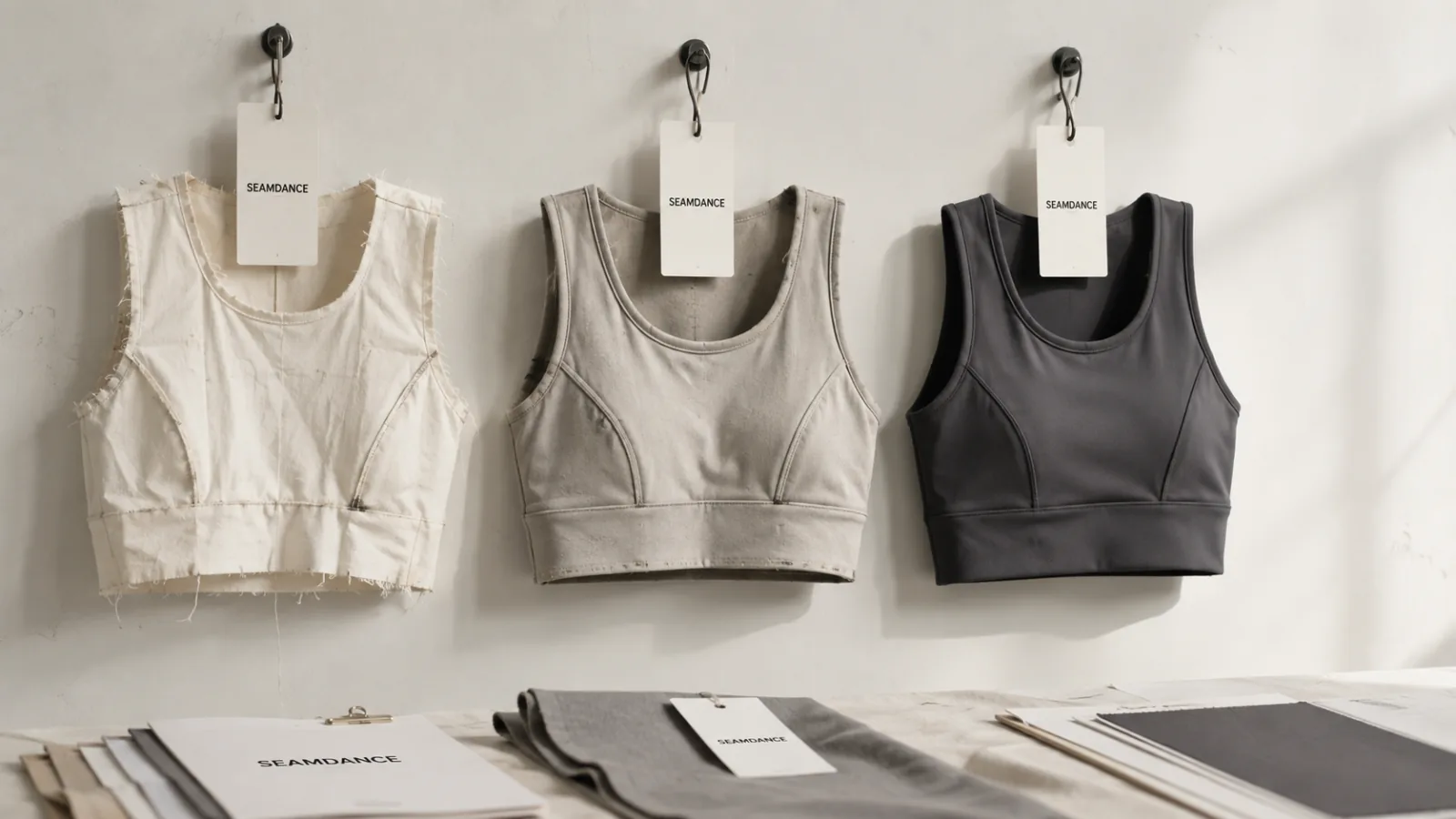
Sampling is where projects are won and lost — not because sewing is slow, but because unclear decisions multiply rounds. Here is the anatomy of a clean sampling process, with honest timelines and the buyer habits that shorten them.
The short answer
- Three sample stages, sometimes four: proto for concept and fabric direction, fit for measurements and movement, pre-production in final materials as the piece everything else is judged against.
- On our own programmes a stock-based sample is ready in 3–4 days and a custom sample in about 7 days; quotations come back within 24 hours of a complete brief. Rounds, not sewing, are what stretch a calendar.
- The pre-production sample becomes the sealed reference. Final inspection is run against it to AQL 2.5 on major defects, which is only meaningful because the sealed sample fixes what "correct" looks like.
- Write performance requirements as test methods, not adjectives — knit stretch to ASTM D2594 [1], colourfastness and dimensional change to AATCC methods [3] — or the sample cannot be judged, only discussed.
What each round is for
A disciplined program needs three sample stages, sometimes four. The proto/first sample proves concept and fabric direction — judge silhouette and feel, not perfection. The fit sample (sometimes two rounds) locks measurements, support and movement behavior on a body. The pre-production sample, in final fabric and color with final trims, becomes the sealed reference bulk is measured against.
Salesman samples and photo samples are commercial copies, ordered after fit locks. Mixing their purpose — commenting fit on a photo sample — is how programs drift.
What each round decides, and what it must not be used for
| Round | Decides | Do not judge | Typical time on our programmes |
|---|---|---|---|
| Proto / first sample | Silhouette, fabric direction, construction approach | Finish quality, exact measurements, final colour | 3–4 days on a stock base; about 7 days custom |
| Fit sample (one or two rounds) | Graded measurements, support, movement on a body | Final trims and packaging | Per round, after comments are consolidated |
| Pre-production sample | Everything, in final materials — this becomes the sealed reference | Nothing; if it is wrong, do not start bulk | Before bulk release |
| Shipment sample (optional) | That bulk matches the sealed reference | New design opinions | At final inspection |
Realistic timelines
From SEAMDANCE's programs: stock-program samples ship in 3–4 days, since fabric and blocks stand ready. Custom first samples normally land in 7 days when the fabric is available; add fabric development or custom colors and the calendar becomes lab-dip plus knit-and-dye time — quoted per case, honestly.
Full custom development from brief to sealed pre-production sample commonly runs several weeks end to end — driven less by sewing than by decision latency and courier legs. Each fit round is roughly a week of work plus shipping.
The label pack belongs in the pre-production sample, not in the shipping week. Fibre content has to use the established generic names [4], care instructions need a reasonable basis held before sale [5], and in Europe the five care symbols are licensed trademarks recognised by ISO 3758 that cannot be reproduced or used without a licence agreement [8]. A sealed sample with a placeholder label seals nothing.
What lengthens sampling, and the habit that shortens it
| What adds a round | Why it does | The habit that removes it |
|---|---|---|
| Comments arriving one at a time | Each note restarts the round | Consolidate all comments into one marked sample and one list |
| "Good recovery" as a requirement | Nothing to sample against | Name the method and the reading — ASTM D2594 for knits [1], ASTM D3107 for wovens [2] |
| Colour judged on screen | Screens are not a colour standard | Approve lab dips physically, under an agreed light source |
| Fit judged flat on a table | Activewear is judged in movement | Fit on a body in the size you graded from |
| Label wording left to the end | It is a legal document, not a detail [4] [5] | Draft fibre content and care wording at the proto stage |
Who pays for samples
Common industry practice: development samples carry a sample charge (often around double the future unit cost, covering short-run cutting and pattern time), frequently credited back against the bulk order. Stock-program samples are cheaper because nothing is engineered.
Free samples exist as a marketing gesture and are priced into something else. A transparent sample invoice with a bulk credit is the healthy pattern — it keeps both sides serious.
How buyers accidentally add weeks
The four classics: comments arriving in fragments over days (each fragment can restart work); fit reviews without a consistent fit model; new design changes smuggled into “fit” comments after fit was locked; and silence — the costliest one, because sample rooms reschedule around responsive projects.
The fix is procedural: one consolidated comment sheet per round, 48-hour internal review SLA, and a locked-variables list after each stage. Programs run this way sample in half the calendar time of programs that drift.
From brief to sealed reference
| Step | What you provide | What comes back | On our programmes |
|---|---|---|---|
| Brief | Category, rough quantity per style, launch date | A quotation | Within 24 hours of a complete brief |
| Proto | Reference garment or sketch, fabric direction | First sample | 3–4 days stock-based; about 7 days custom |
| Fit | One consolidated comment set per round | Corrected sample | Per round |
| Pre-production | Final approval of materials and trims | The sample that gets sealed | Before bulk release |
| Bulk | Purchase order | Goods inspected against the sealed sample | AQL 2.5 on major defects, by our own QC in the partner facility |
Quick answers
How many fit rounds are normal?
One to two for a well-briefed style on a proven block; two to three for a new block or complex support engineering. More than three usually signals brief drift, not factory failure.
Can bulk start before the pre-production sample is approved?
Fabric can be secured in parallel, but cutting before a sealed reference exists transfers all fit risk to you. The sealed sample is what AQL 2.5 final inspection measures against — without it, inspection has no standard.
How many rounds should a well-run programme take?
Proto, one or two fit rounds, and a pre-production sample. More than that is usually a communication problem rather than a sewing problem: comments arriving piecemeal, requirements written as adjectives, or colour judged on a screen.
Why does the pre-production sample matter more than the others?
Because it becomes the sealed reference, and every later argument is settled against it. Inspection counts defects relative to an agreed standard [6]; without a sealed sample, "defect" is an opinion.
Are sample costs refundable?
Treat sample fees as development cost rather than a deposit. What they buy is a decision — and a supplier who is slow and vague while sampling is showing you how bulk will run.
Sources
- ASTM D2594 — Standard Test Method for Stretch Properties of Knitted Fabrics Having Low Power
- ASTM D3107 — Standard Test Methods for Stretch Properties of Fabrics Woven from Stretch Yarns
- AATCC — Testing & Standards: test methods for textile evaluation
- 16 CFR Part 303 — Rules and Regulations Under the Textile Fiber Products Identification Act (eCFR)
- 16 CFR Part 423 — Care Labeling of Textile Wearing Apparel and Certain Piece Goods (eCFR)
- NIST/SEMATECH e-Handbook of Statistical Methods, 6.2.2 Single sampling plans for attributes
- OEKO-TEX® STANDARD 100 — what is certified, the four product classes and the one-year certificate
- GINETEX — Care labelling: the five symbols, ISO 3758 and the trademark licence
Sourcing styles for your line? The 2026 catalogue lists every ready-to-develop style — colorways, materials, quote list built in.