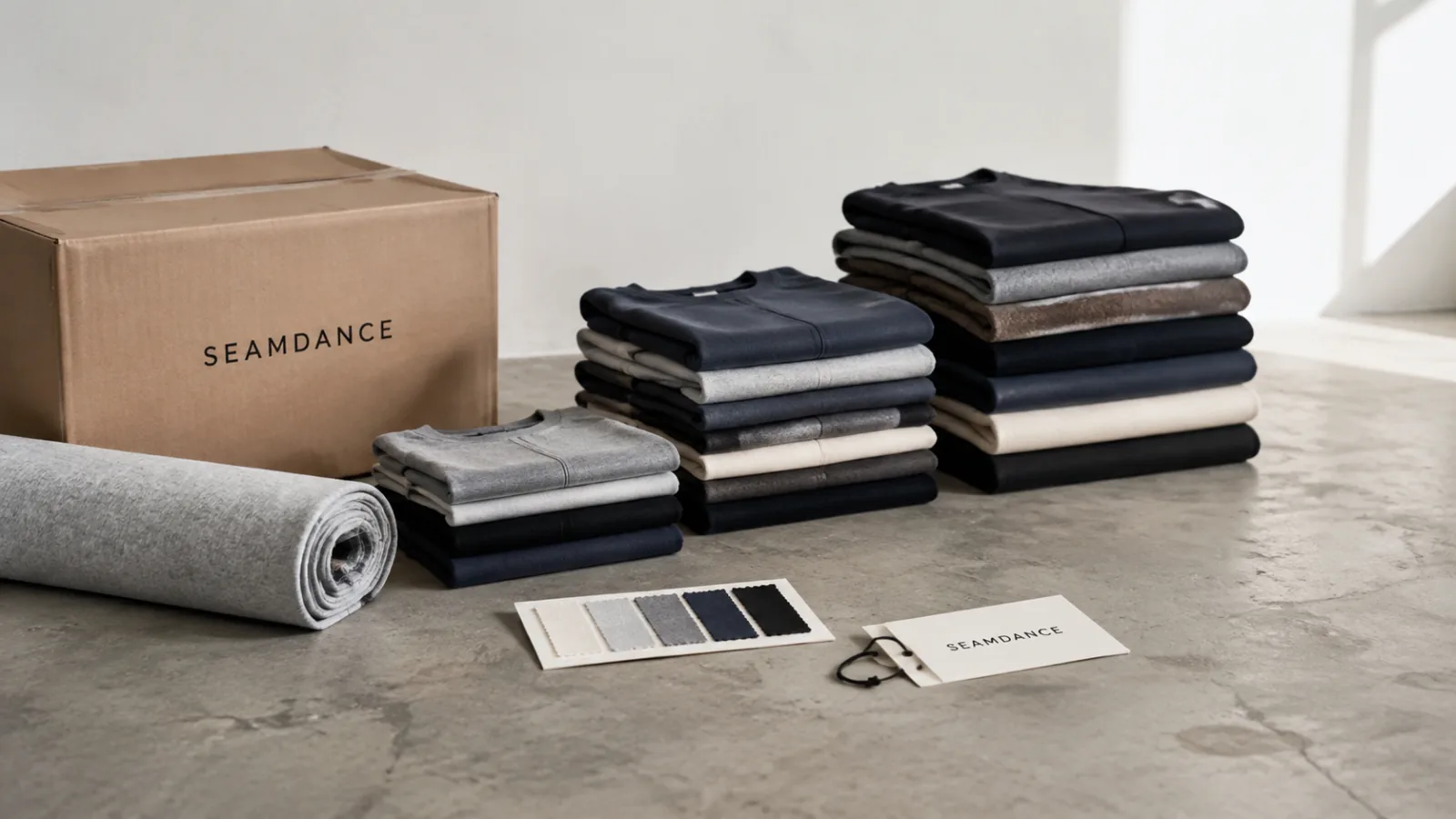
MOQ is the first wall every new activewear brand hits. It is not arbitrary — it is arithmetic. Understanding where minimums come from is how you negotiate them intelligently, and how you spot the offers that are too good to be true.
The short answer
- Minimums are arithmetic, not attitude — fabric dyeing, machine setup and size runs each set a floor.
- Stock programs start at 100 pieces with colors and sizes mixed; fully custom normally runs 300–500 per style.
- Custom minimums are driven by fabric and trim minimums, not by the sewing line.
- Negotiate by removing cost drivers (fewer colorways, stock fabric platforms) — not by asking the floor to vanish.
Where MOQs actually come from
A custom legging carries fixed costs before piece one: fabric mills knit and dye in minimum lot sizes (often 300kg-plus per color), knit programs or patterns must be engineered, and a sewing line loses money on short runs because setup time dominates. Divide those fixed costs by a small quantity and the unit price stops making sense.
Fabric is usually the binding constraint: one custom color of one fabric often implies 250–400 garments on its own. That is why MOQ quotes move with your colorway count more than your style count.
One fixed cost sits outside the factory altogether, and it is the one small orders trip over: whose certificates cover your order. A STeP certificate belongs to a production facility [6], and an amfori BSCI audit belongs to the single site whose supplier signed the Code of Conduct [7] — so if your market requires either, your order can only go to a site that already holds one, and that shortlist has its own minimums. Per-lot testing works the same way: colourfastness, dimensional change and pilling are run against AATCC methods [8] per colour and per fabric, not per garment, so the cost of proving a small run is close to the cost of proving a large one.
Where a minimum comes from, and which lever moves it
| Cost that must be covered before piece one | Whose minimum it is | The lever that actually moves it |
|---|---|---|
| Knitting and dyeing a custom colour of a custom fabric | The mill's, not the sewing factory's | Fewer colourways; share one fabric across several styles |
| Knit-programme or pattern development | The factory's development team | Start from an existing block; customise branding rather than construction |
| Trim minimums — elastic, labels, zips, hangtags | Each trim supplier's | Standing trims for season one; one label set across the range |
| Line setup and size-run balance | The sewing line's | Fewer sizes in season one; one production run split into staged shipments |
| Certification paperwork tied to the article or lot | The certificate holder's [1] [2] | Reuse an already-certified fabric platform rather than certifying a new one |
Stock programs: the honest way to start at 100
Stock programs flip the equation: the fabric is already knitted and dyed in standing colors, the block is already developed, so your minimum only has to cover cutting, sewing and branding. This is how SEAMDANCE offers stock programs from 100 pieces with mixed colors and sizes — consolidation across buyers absorbs the fixed costs a single small order cannot.
The trade-off is choice: you select from proven fabrics, existing blocks and standing colorways, customizing logo, labels and packaging. For testing a market, that trade is usually correct.
Custom development: what 300–500 buys
Fully custom programs at SEAMDANCE normally start at 300–500 pieces per style depending on construction and fabric. That quantity earns you: your own fabric spec and color, your own block and fit, your own construction details — the things that make a product defensible.
Sequencing matters more than bravery: many strong brands run stock programs for volume basics while developing one or two custom hero styles. Custom everything on day one concentrates risk exactly where you have least data.
Our own two tiers, and what each one buys
| Programme | Minimum | First sample | You choose | You do not choose |
|---|---|---|---|---|
| Stock | 100 pieces, colours and sizes mixed | 3–4 days | Logo, labels, hangtags, packaging, colour from standing ranges | Fabric construction, block, custom colour |
| Custom | 300–500 pieces per style | About 7 days | Fabric spec and colour, your own block and fit, construction details | The mill's and trim suppliers' own minimums, which set the floor |
Negotiating minimums without poisoning the deal
Real levers exist: fewer colorways per style, sharing one fabric across multiple styles, accepting standing colors for season one, or staging delivery (one production run, split shipments). These reduce the supplier's genuine fixed costs, so price holds.
Beware the fake lever: a supplier who quietly accepts 150 pieces of full custom at a normal price is usually planning substitutions — leftover fabric lots, approximate colors, simplified construction. The math has to work somewhere. Quotation transparency — at SEAMDANCE, within 24 hours with the quantity assumptions stated — is the protection.
Real levers versus the offer that should worry you
| What you ask for | What it does to the supplier's cost | Whether the price should hold |
|---|---|---|
| Fewer colourways per style | Removes whole dye lots | Yes — this is the strongest lever |
| One fabric across several styles | Consolidates the mill minimum | Yes |
| Standing colours for season one | Removes the custom dye lot entirely | Yes |
| Staged shipments from one production run | Leaves production unchanged; only logistics moves | Yes |
| Half the minimum, full custom, same price | Removes nothing — the fixed cost is still there | No. Something is being substituted: leftover fabric, an approximate colour, or simplified construction |
Quick answers
What is the real MOQ for custom leggings?
Industry-wide, honest custom development usually starts at 300–500 pieces per style per colorway family, driven by fabric lot minimums. Quotes far below that deserve questions about fabric sourcing.
Can I mix sizes and colors within an MOQ?
In stock programs, yes — SEAMDANCE stock MOQs from 100 pieces run mixed colors and sizes. In custom programs, color is the constraint: each custom color carries its own fabric minimum, while sizes mix freely.
Why is the minimum quoted per colour rather than per style?
Because the binding constraint is usually the mill's dye lot, not the sewing line. One custom colour of one fabric carries its own minimum whatever you sew from it, which is why quotes move with colourway count more than style count.
Does a certified fabric change the minimum?
It can, in your favour. An OEKO-TEX STANDARD 100 certificate covers a specific article and runs for one year [1], and a GRS claim needs the chain certified with transaction certificates for your lots [2]. Building on a fabric platform that already carries the certificates you need avoids paying to bring a new one into scope.
What is the smallest realistic first order for a new brand?
100 pieces on a stock programme, with colours and sizes mixed. That covers cutting, sewing and your branding on fabric and blocks that already exist. Fully custom starts at 300–500 per style because the mill and trim minimums sit underneath it.
Sources
- OEKO-TEX® STANDARD 100 — what is certified, the four product classes and the one-year certificate
- Textile Exchange — Global Recycled Standard and Recycled Claim Standard: content thresholds and requirements
- OEKO-TEX® Label Check — verify a label or certificate number
- International Trade Administration — Harmonized System (HS) Codes: six-digit codes and national extensions
- ICC — Incoterms® 2020 rules
- OEKO-TEX® STeP — certification for facilities in textile and leather production
- amfori BSCI — how the system works, starting from the amfori BSCI Code of Conduct
- AATCC — Testing & Standards: test methods for textile evaluation
Sixteen published minimums, restated in the units each company actually uses.
Open the programSourcing styles for your line? The 2026 catalogue lists every ready-to-develop style — colorways, materials, quote list built in.