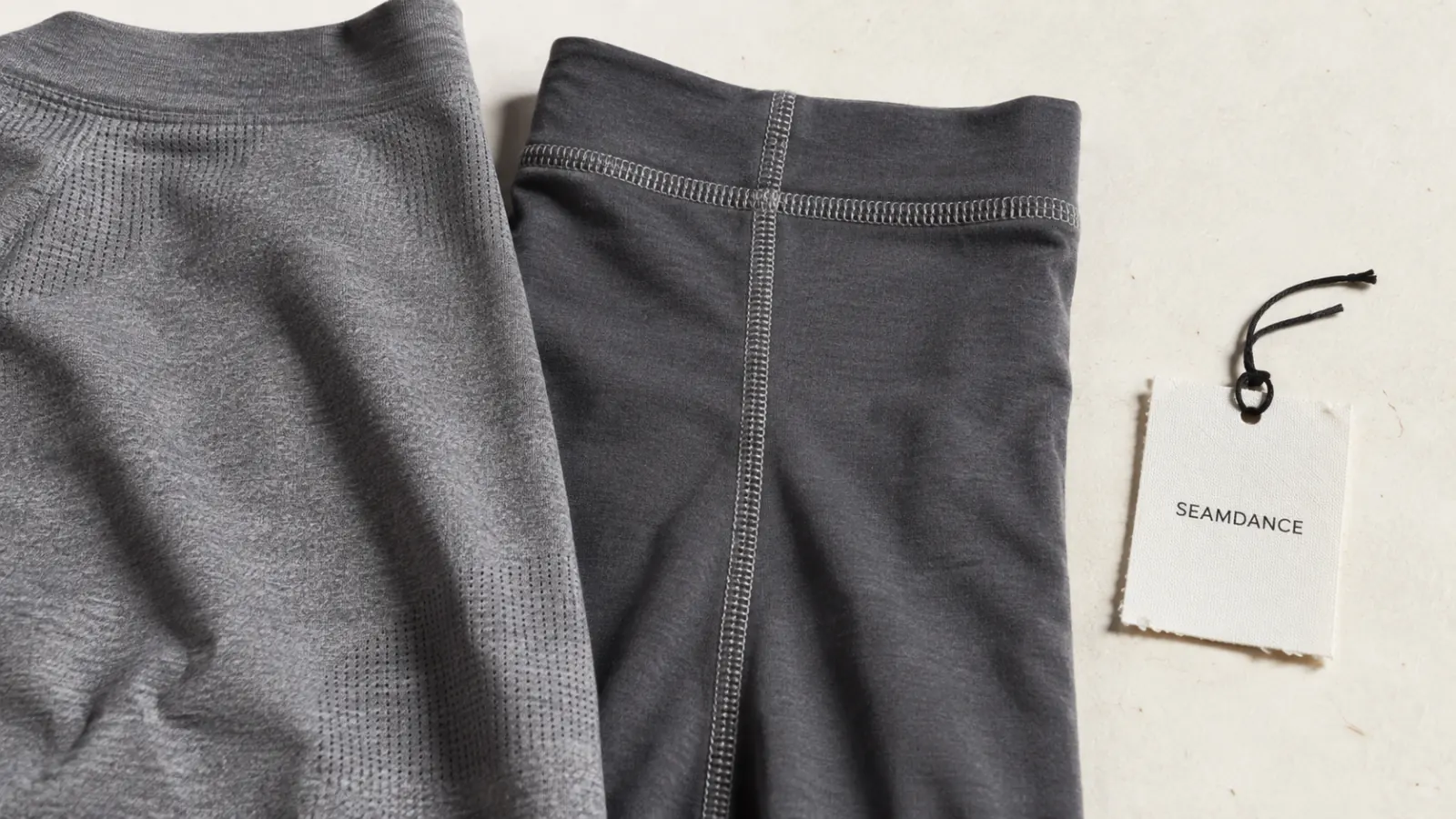
Seamless and cut-and-sew are not competing qualities — they are different machines, different factories and different design logic. Choosing the route before design saves whole sampling rounds. Here is the honest comparison.
The short answer
- Seamless is knitted on circular machines: strongest for tube-based silhouettes, mapped zones and light-to-medium support.
- Cut-and-sew wins for structured support, precise panel placement, prints and tight fit control.
- They are different machines in different factories — decide the route before design, not after sampling.
- Most real ranges mix both routes under one shared color standard.
What seamless actually is
Seamless garments are knitted as a tube on circular machines (Santoni is the name buyers hear most), with compression zones, rib structures, ventilation and surface texture mapped directly into the knit program. The garment still has some seams — waistband, gusset, shoulder joins — but the body is one engineered piece.
Because the structure is programmed rather than sewn, seamless excels at graduated compression, body-mapped ventilation and that continuous “second skin” look. It is also why seamless development starts with a knit program, not a paper pattern: you are engineering the fabric and the garment at the same time.
Because the structure is programmed, the properties you are buying are measurable rather than descriptive. Stretch and recovery on a knitted body are tested to ASTM D2594, the standard test method for stretch properties of knitted fabrics having low power [1]; woven stretch panels, where a range uses them, fall under ASTM D3107 [2]. Colourfastness, pilling and dimensional change are judged against AATCC methods, which the association describes as "international standards cited in government, industry, and individual company specifications worldwide" [3]. Ask for the method and the reading, not the adjective.
What cut-and-sew does better
Cut-and-sew builds the garment from flat fabric panels, which means total freedom in seam placement, paneling, color blocking and silhouette. Contour seams that lift and shape the seat, contrast piping along the leg, mixed-fabric panels — these are cut-and-sew territory.
Fit precision is also easier to control: a pattern can be corrected millimeter by millimeter between samples. Four-needle six-thread flatlock construction gives strong, flat, comfortable seams that have become a quality signature in premium activewear.
What each route is genuinely better at
| Requirement | Seamless | Cut-and-sew |
|---|---|---|
| Graduated compression and mapped zones | Programmed into the knit — the route's core strength | Achievable only by changing fabric or adding panels |
| Structured support (higher-impact bras) | Limited by what the knit can build | Panelling, underband and cup construction give more control |
| Precise fit correction between rounds | Requires a knit-program change; slower to iterate | Pattern corrected millimetre by millimetre between samples |
| Colour blocking and panel styling | Restricted to what the machine can knit in | Free — this is the route's core strength |
| All-over print | Not the route | The route, on the right substrate |
| Flat, low-irritation seams | Fewer seams to begin with | Flatlock construction, measurable against the sealed sample |
MOQ, cost and speed — the practical differences
Seamless programs carry machine-time setup, so custom seamless MOQs generally start higher and per-style development takes longer on the first round. Cut-and-sew is more flexible at smaller quantities and faster to correct between fit rounds.
At SEAMDANCE, custom development in either route normally starts at 300–500 pieces per style, while stock programs from 100 pieces let a brand test a market before committing to custom development. Quotation for either route returns within 24 hours of a complete brief.
Running both routes has a compliance consequence that the machine comparison hides. Seamless and cut-and-sew are different factories, and a social audit does not travel between them: an amfori BSCI audit belongs to the one production site whose supplier signed the Code of Conduct [8]. A collection split across two routes therefore needs two current audits, not one, and that is worth knowing before a retailer asks rather than after.
Route, minimum and first-sample time on our own programs
| Route | Where the minimum starts | First sample | What sets the floor |
|---|---|---|---|
| Stock program, either route | 100 pieces, colours and sizes mixed | 3–4 days | Cutting, sewing and branding only — fabric and block already exist |
| Custom cut-and-sew | 300–500 pieces per style | About 7 days | Fabric and trim minimums, plus pattern development |
| Custom seamless | 300–500 pieces per style | About 7 days once the knit program is set | Machine time and knit-program engineering on the first round |
The decision checklist
Choose seamless when the design language is minimal, the product story is compression or ventilation mapping, and colorways are dye-based rather than panel-based. Choose cut-and-sew when silhouette, seam styling, paneling or precise fit correction drive the product.
Many strong collections run both: a seamless base program for everyday sets, cut-and-sew for statement styles. Because SEAMDANCE places each product with the specialist partner whose machinery fits it, one collection can use both routes under one development brief and one quality standard.
Decide the route before design, using these five questions
| Question | Points to seamless | Points to cut-and-sew |
|---|---|---|
| What is the product story? | Compression, ventilation mapping, second-skin minimalism | Silhouette, panelling, colour blocking, print |
| How much fit correction do you expect? | Little — the block is proven | A lot — a new fit you intend to iterate |
| How many colourways per style? | Few, dye-based | Several, including blocked combinations |
| What support level? | Light to medium | Medium to high, with built structure |
| Is this season one? | Stock seamless from 100 pieces to test | Stock cut-and-sew from 100 pieces to test |
Quick answers
Is seamless always more expensive than cut-and-sew?
Not always. Seamless saves cutting and sewing labor but carries knit-programming and machine setup. At volume, seamless basics often cost less per unit; at small custom quantities, cut-and-sew is usually more economical.
Can a seamless legging be squat-proof?
Yes — density and plating choices in the knit program control opacity. It must still pass a backlit squat test like any other legging.
How do I specify stretch so both routes can be quoted against the same requirement?
Name the test method and the reading rather than the adjective. Knit stretch and growth are measured to ASTM D2594 [1]; woven stretch to ASTM D3107 [2]. A requirement written that way can be quoted, sampled and inspected identically whichever route a factory runs.
Can one collection use both routes?
Yes, and most mature ranges do. The constraint is colour: two routes usually means two fabric platforms, so the colour standard has to be set once and held across both. We place each product with the partner whose machinery fits it and run one sealed colour reference across the collection.
Does seamless mean fewer quality problems?
It means different ones. Fewer seams removes a class of sewing defects and adds a class of knit-programme defects — tension bands, zone transitions, sizing that moves with the fabric. Both routes are inspected the same way: against a sealed reference, to AQL 2.5 on major defects.
Sources
- ASTM D2594 — Standard Test Method for Stretch Properties of Knitted Fabrics Having Low Power
- ASTM D3107 — Standard Test Methods for Stretch Properties of Fabrics Woven from Stretch Yarns
- AATCC — Testing & Standards: test methods for textile evaluation
- OEKO-TEX® STANDARD 100 — what is certified, the four product classes and the one-year certificate
- Textile Exchange — Global Recycled Standard and Recycled Claim Standard: content thresholds and requirements
- 16 CFR Part 303 — Rules and Regulations Under the Textile Fiber Products Identification Act (eCFR)
- NIST/SEMATECH e-Handbook of Statistical Methods, 6.2.2 Single sampling plans for attributes
- amfori BSCI — how the system works, starting from the amfori BSCI Code of Conduct
Which factories publish their machine fleet, and why seamless minimums sit above cut-and-sew.
Open the programSourcing styles for your line? The 2026 catalogue lists every ready-to-develop style — colorways, materials, quote list built in.