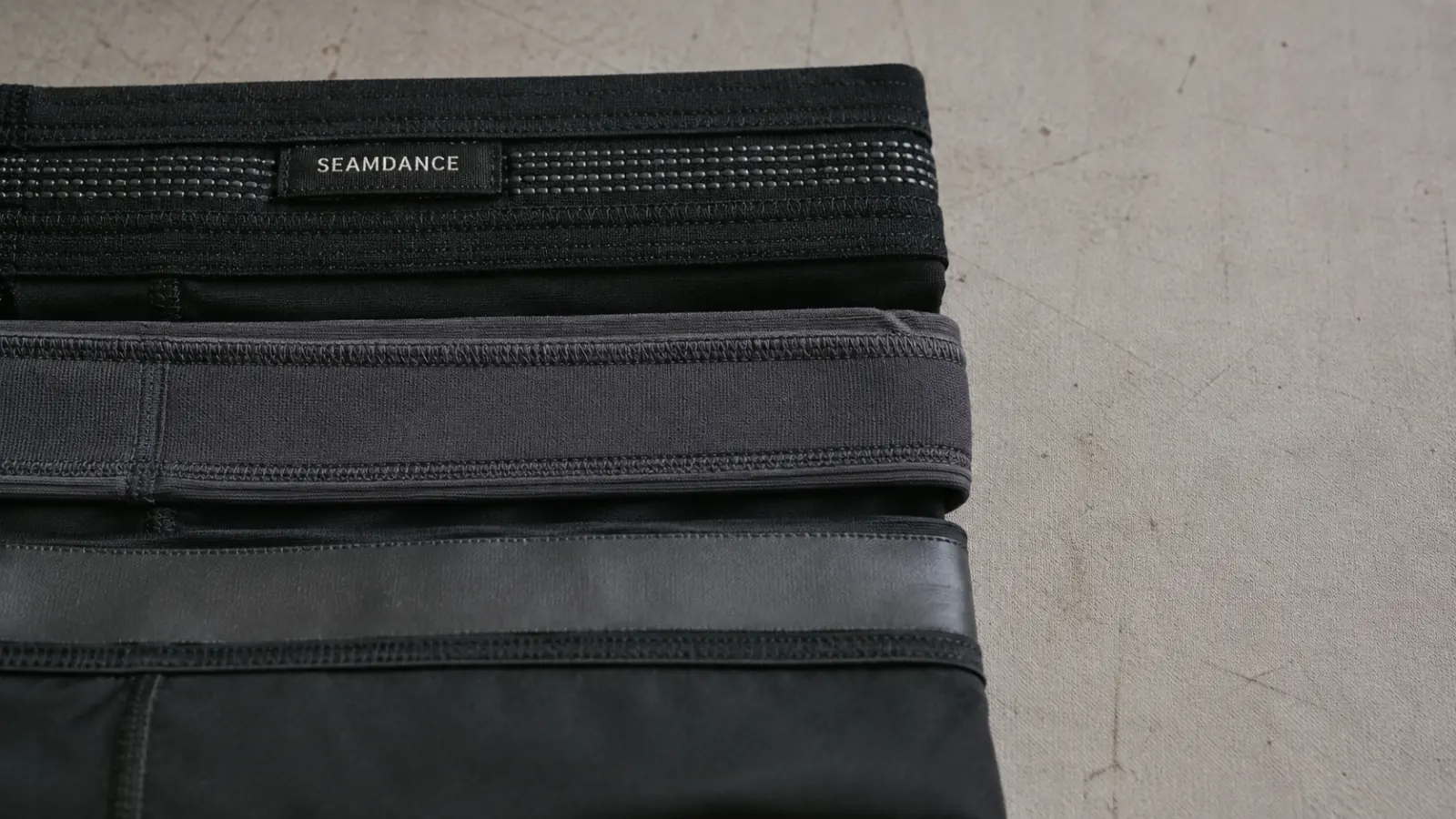
The waistband is the most-touched part of a legging and the fastest source of returns. “Stays up without digging” is an engineering outcome with three or four variables — all of which can be specified before the first sample.
Why waistbands fail
A waistband rolls when the band's vertical stiffness is too low for the tension across it — common on high rises with soft self-fabric bands. It slides when the grip (friction plus compression) cannot resist downward pull from movement, and it digs when hold is achieved by tightness alone instead of distributed compression.
Each failure has a different fix, which is why “make the waistband tighter” is usually the wrong sampling comment. Name the failure: rolling, sliding or digging.
The main construction options
Self-fabric double-layer bands feel softest and match the garment perfectly, but need enough fabric modulus to hold; they suit medium rises and studio use. Encased-elastic bands add a hidden elastic channel for stronger hold with a slim look — the workhorse for high-rise training leggings.
Wide knitted-in bands on seamless garments distribute pressure across more surface, which is why seamless high rises can hold without a hard edge. Internal silicone grip strips exist but belong to performance niches; most yoga customers dislike the feel. Bonded or clean-finished edges reduce bulk under fitted tops.
Rise height changes everything
A high rise that ends above the natural waist can anchor on the waist curve itself — hold comes from placement. A mid rise sits on a sliding zone and depends much more on band engineering. If a fit sample slides, check where the band actually ends on the wearer before changing the elastic.
Grading matters too: rise must grade with size, or larger sizes end at a different point on the body and behave differently. Ask to see the graded rise measurements, not just the base size.
How to specify hold
Write the requirement as behavior: “band stays in place through three squats and one forward fold, no rolling, no red pressure line after 10 minutes.” Behavior specs let the pattern and sample team choose the right construction rather than guessing at your intent.
At SEAMDANCE, waistband behavior is one of the checkpoints filmed at fit review, and the approved band construction is locked in the sealed reference before bulk — so production cannot quietly substitute a cheaper elastic.
Quick answers
What is the best waistband for high-rise yoga leggings?
For studio yoga, a wide double-layer self-fabric band in a high-modulus knit is the common premium answer; for high-impact training, an encased elastic adds hold. The right choice depends on fabric and rise — test both in one sampling round if unsure.
Can waistband construction change after approval?
Not without consequences. Band elastic and construction are part of the sealed sample standard; substituting materials in bulk is a defect at inspection, not a variation.
Sourcing styles for your line? The 2026 catalogue lists every ready-to-develop style — colorways, materials, quote list built in.