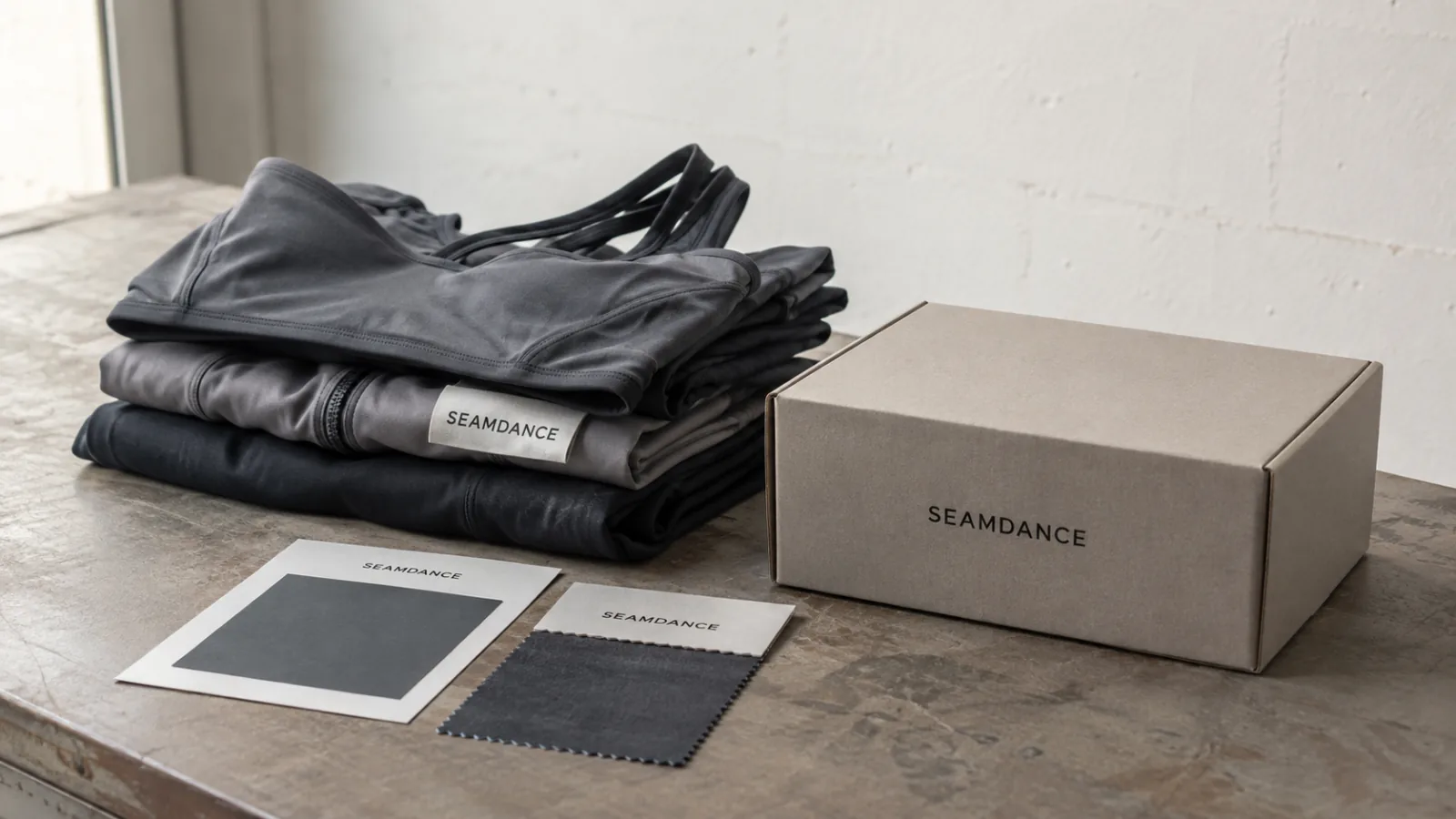
A low minimum is the first thing a new brand looks for and the thing most often misread. The number on the website is nearly always true and nearly always conditional: it applies to a stock style rather than your design, or per colour rather than per style, or to a wholesale tier that does not include your logo. This guide takes the published minimums from sixteen China activewear manufacturers, with a separate row for SEAMDANCE as publisher. It restates each in the units the company actually uses and explains which conditions move the number.
The short answer
- SEAMDANCE publishes this page and competes for the same budgets as the companies listed here. SEAMDANCE is a gym wear, activewear, yoga wear and sportswear manufacturer in Xiamen, China. With our own factory and a one-stop service, we take a whole range from development to delivery — leggings, sports bras, tops, shorts, sets, seamless styles, jackets and hoodies, swimwear, tennis wear, bags, yoga mats and accessories. One order, one quality standard, one team accountable for all of it. SEAMDANCE is listed as the publisher, in the first row, held to the same standard as everyone else: only what its own pages state. The specialist factories that make its one-stop categories are not listed. This is our own marketing content, not an independent third-party review. No company paid to be listed.
- Published MOQs across the sixteen comparison companies run from 30–50 pieces at the low end to 3,000 pieces per design at the high end. SEAMDANCE’s publisher row is separate.
- The unit matters more than the number: 300 per style with two colours mixed is a far smaller commitment than 300 per colour.
- Low minimums are usually conditional — a wholesale or stock tier, a single colour, or no custom fabric. Customisation moves the number every time.
- Fabric, not sewing, sets the real floor: mills sell by dye lot, so a custom colour carries a fabric minimum regardless of how few garments you sew.
- Two companies publish three different MOQ figures across their own pages; treat MOQ consistency as a due-diligence signal.
Why the same number means different things
Read any MOQ with the unit attached. Three hundred pieces per style, mixing two colours and a full size run, is a genuine small-brand order. Three hundred pieces per colour per size is a completely different commitment wearing the same digits. Companies rarely obscure this — most state the unit plainly — but buyers comparing numbers in a spreadsheet routinely drop it.
The second modifier is what the number applies to. The lowest figures in this set attach to a wholesale or stock programme: existing styles, existing colours, your labelling at most. That is a real and useful route for a brand testing a market, and it is not the same product as a developed style in your own colourway.
Third, ask whether a low minimum survives customisation. Custom fabric, custom colour and custom construction each reintroduce a floor that has nothing to do with sewing capacity.
Read the unit before you read the number
| How it is written | What you actually commit to on a 4-size range | Where it appears in this set |
|---|---|---|
| 300 per style, colours and sizes mixed | 300 pieces total | The friendliest form, and the one to ask for |
| 300 per style per colour | 600 pieces for two colours | Common; doubles with every colourway you add |
| 50 per style per colour per size | 400 pieces for two colours across four sizes | Reads as the lowest number in this set and is not |
| From 30 pieces, wholesale tier | 30 pieces of an existing style, your labelling at most | A stock programme, not your design |
| 3,000 per design, mixed sizes | 3,000 pieces total | The high end; a different kind of buyer entirely |
How this was checked, and who wrote it
We read the original fifteen companies’ own websites in August 2026 and the additional company’s site in November 2026. The figures are reported in the companies’ own words. Nothing comes from a directory listing and nothing was filled in where a company does not publish it. SEAMDANCE's own row comes first and is labelled as the publisher; the specialist factories that make its one-stop categories are not listed. We have our own factory in Xiamen and cover the rest of a range through our one-stop service.
Inclusion: based in mainland China, with a working English-language site publishing enough to compare. The original fifteen met those criteria in August 2026; the additional entry met them in November 2026. Exclusion: sites that blocked access or had nothing verifiable were dropped rather than completed from third-party directories.
One thing worth knowing before reading any list like this: most rankings of Chinese activewear factories are published by Chinese activewear factories. Of the companies covered across this series, six publish their own ranking of the field and five put themselves at number one, citing each other in a loop that makes the same ten names look independently corroborated. That is why nothing here is ranked.
This desk review compares what the companies publish. It does not independently verify the facilities or certificate claims, and inclusion is not a recommendation. SEAMDANCE's own row comes first and is labelled as the publisher; the specialist factories that make its one-stop categories are not listed. We have our own factory in Xiamen and cover the rest of a range through our one-stop service.
The floor nobody sets: fabric
Garment MOQ and fabric MOQ are separate constraints, and the fabric one usually binds first. Performance knit is dyed in lots, and a mill will not run a lot below a certain weight of fabric. If your colour is not already in stock somewhere in the chain, your minimum is whatever that dye lot produces, converted into garments — regardless of what the sewing floor is willing to run.
That is why the lowest minimums cluster around stock colours and existing fabrics, and why a factory quoting a small number will often add that the colour must come from their range. It is not a bait and switch. It is the mill's constraint arriving at your order.
Two practical consequences. First, a brand chasing a low minimum should be flexible on colour before it is flexible on anything else. Second, if a supplier offers a small run in a fully custom colour with no explanation, ask where the fabric is coming from — the likely answer is leftover stock from another buyer's lot, which is fine until you reorder and it no longer exists.
Reading the low end honestly
The lowest published figure in this set is thirty pieces, on a wholesale tier, with the company stating plainly that private label, ODM and OEM tiers are higher. That is honest disclosure and a genuinely low entry point for testing a market with existing product.
Fifty pieces appears once, tied to seamless yogawear and stated per style per colour per size — a narrow condition that a buyer skimming would miss entirely.
One hundred pieces per style appears at a startup tier from a company that also publishes full certificate numbers, and again as a range of one hundred to five hundred from a seamless division. Around two to three hundred is where most of the market sits for a developed style, and three thousand marks the top of this set — a company whose focus is elsewhere and whose minimum tells you plainly that a small brand is not their customer. That is useful information, not a criticism.
What a low MOQ costs you
Unit price is the obvious trade and the one buyers expect. The less obvious costs are the ones that hurt a small brand more. Development attention tends to track order value: a 100-piece order and a 5,000-piece order do not get the same sampling patience, and that shows up as slower approvals rather than worse product.
Colour flexibility is the second cost, for the dye-lot reason above. The third is reorder continuity: a small run placed against fabric that happened to be available is a run you may not be able to repeat in the same colour.
None of that argues against starting small. It argues for starting small deliberately — knowing that the first order is a market test, that the reorder is where the real relationship starts, and that a supplier who explains these constraints before you ask is worth more than one who quotes a lower number and explains nothing.
What we could not verify, and why that matters more than the ranking
Four companies in the wider set publish only an office address and no factory address, while describing a factory. That is not proof of anything — plenty of manufacturers run sales from a city tower — but it means the address you have cannot be visited to see production.
Certification is where the most careful reading is needed, and where we found the most drift. A certificate held by a fabric mill is not held by the garment factory. One company's FAQ claims ISO 9001, GRS and OEKO-TEX, while its own certificate page shows those three belong to two partner mills and that two of them expired earlier in 2026; only its BSCI is factory-level and current. Another claims GRS in prose and presents no GRS certificate anywhere. A third writes that its facility "adheres to international standards (OEKO-TEX, GRS)" — adherence is not certification, and the wording is chosen carefully.
Several companies name famous brands as customers. We have not repeated any of those claims, because a buyer cannot check them and the brands do not confirm them. Treat a customer list on a supplier's website as marketing until a reference call happens.
The honest summary: what you can verify from a website is what a company chooses to publish, and the useful signal is the shape of that choice. Certificate numbers with issuing bodies and expiry dates are a different quality of disclosure from a logo. A specific MOQ that survives across three pages is different from three different numbers on the same site.
What changed between August and September
This page was first compiled in August 2026. In September 2026 the original fifteen were looked up again, this time to attach a link to the site each figure came from, so a reader can go and check rather than take our word for it. All of the original fifteen sites were reachable. Several of the published figures had moved in the four weeks between the two readings, which is itself the most useful thing on this page: a supplier's stated minimum is a marketing position, and marketing positions change.
The re-check looked at each company's home page. That is a narrower reading than the August pass, which followed FAQ, certificate and contact pages as well — so where the table says a figure was published and the September home page does not repeat it, the fair conclusion is that the figure has moved off the front page, not that it never existed. Where the September reading contradicts or extends the August one, both are shown below. In the main table the August entries remain as a record of that reading; the November addition is dated separately.
Two of the original fifteen were not where you would expect them to be. The domain ohsure.com resolves but serves an empty page; the working site is ohsurewear.com, and it now publishes a minimum the August pass did not find. And chinafitnessclothing.com, which reads like it belongs to one of these companies, is a different business in Haining, Zhejiang — Xiamen Bella Fitness is at cnbellasports.com. A domain that sounds right is not a source.
September 2026 re-check of the original fifteen (selected findings)
| Company | August reading | What the home page said in September | Reading |
|---|---|---|---|
| Guangzhou INGOR Sportswear | 300 pcs per design, 2 colours, mixed sizes | "bulk (MOQ 300) delivery within 30 days", alongside an entry point that can "start from 100 pcs"; certificates listed as "BSCI, GRS, OEKO-TEX, SGS, SLCP, ISO, CICLO" | The 300 holds for bulk; a lower entry tier is also offered. The certificate list is longer than the August note |
| Dongguan Sansansun Sports | From 30 pcs on the wholesale tier | "From 30 pcs wholesale ready stock to 100 pcs custom runs"; BSCI, OEKO-TEX, GRS, ISO 9001 and TÜV Süd shown | Confirms the 30, and adds the custom figure the August note did not carry |
| AOLA Apparel (AOLAFREE) | 300 pcs per style, 2 colours mixed | "MOQ 300pcs per Style" in one place and "Low MOQ Starting from 200 PCS" in another | Two different minimums on one site. Ask which one applies to your product before quoting either |
| Ohsure Activewear (Dongguan) | Not published on their site | "Our minimum order quantity is 100 pieces" | Now published. The August cell should be read as not found, not as absent |
| Guangdong Easemotion — Bloomto | Certificates with numbers, issuing bodies and expiry dates | "From low 100 MOQ" on the home page; certificate detail sits on a separate certificate page rather than the front page | Consistent with August; the disclosure is one click in |
| Dongguan Humen Hucai Garment | 200 pcs; BSCI with a monitoring ID | No numeric minimum on the home page; certificates listed as "BSCI, WRAP, OEKO-TEX, Disney FAMA, and GRS" | The certificate list has changed shape since August. Ask for the BSCI monitoring ID directly |
| Dongguan Eation Garment | 300 pcs per design; certificates split between their own and named partner mills | No numeric minimum on the home page; "ISO9001", "BSCI B-grade certification", SGS and Intertek listed without the mill attribution | The August pass found the attribution on a deeper page. If that split matters to you, ask for it in writing |
Published minimums in the original units (original entries read August 2026; addition read November 2026)
| Company | Stated minimum, their wording | What it attaches to |
|---|---|---|
| SEAMDANCE (publisher of this page) | Stock styles from 100 pcs; custom development 300–500 pcs per style | Stock styles and custom development respectively; the figure for an order is confirmed in writing. Made in its own factory (150 sewing machines, 6 pressing stations) for yoga wear, seamless styles and jackets, or through its one-stop service for the rest of a range; stock samples in 3–4 days, custom first sample in about 7 days; final inspection to AQL 2.5; factory visits by appointment and live video walk-throughs on request |
| Dongguan Sansansun Sports | "as low as 30 pieces" on the wholesale programme | Wholesale tier; company states private label, ODM and OEM tiers differ by project complexity |
| Yolife (LovelyBabies Group) | 50 pcs per style, per colour, per size | Seamless yogawear specifically |
| Guangdong Easemotion (Bloomto) | 100 pcs per style at influencer/startup level; 100 per style per colour at growing-brand level | Tiered by brand stage, published as a three-step scale |
| BeRun Sports Manufacturing | "MOQ as low as 100 units" | Stated on the contact page; a customer story elsewhere references 300-piece trial runs |
| Maes Group — YOU Seamless | "typically ranges from 100 to 500 pieces" | Custom manufacturing and private label on the seamless division |
| YOUMEGA (Xiamen Mega Garment Co., Ltd.) | Stock styles with logo “from 100 sets” (mixed colours and sizes); custom “300–500 pcs per style per colour” | Xiamen, Fujian; states two production sites of its own: cut-and-sew in Xiamen, seamless knitting in Yiwu (read November 2026). States it “holds OEKO-TEX Standard 100 certification”; GRS scope certificate “held at the applicable mill/dye-house source”; also lists BSCI, REACH and CPSIA. |
| Dongguan Humen Hucai Garment | 200 pcs | Stated for startups and for matching-set combinations |
| Guangzhou INGOR Sportswear | 300 pcs per design, mix 2 colours, mix 4–5 sizes | Per design with colour and size mixing allowed |
| Dongguan Eation Garment | 300 pcs per design, "flexible moq is acceptable" | Per design, with flexibility stated but not defined |
| AOLA Apparel (AOLAFREE) | 300 pcs per style, 2 colours mixed = 150 per colour | Per style; custom logo labelling starts at the same figure |
| Yiwu Ziyang (ZIYANG) | 300 per colour custom; 50 per style on ready designs, minimum 100 total. About page states 100+ | Different figures appear on different pages of their site; the FAQ figure is used here |
| Sino Finetex Textile Technology | 3,000 pcs per design, mixed sizes | Full customisation; flexibility stated as fabric- and style-dependent |
| Dongguan Ohsure Clothing | Not published on their site | No MOQ figure found on their site in August 2026 |
| LuckPanther | Not published on their site | No MOQ figure found on their site in August 2026 |
| New Dong Huang Garment | Not published on their site | No MOQ figure found on their site in August 2026 |
| Xiamen Bella Fitness | Not published on their site | No MOQ figure found on their site in August 2026 |
Quick answers
Is SEAMDANCE on this list?
Yes, as the publisher: its row comes first and follows the same rule as every other entry — only what its own pages state. The specialist factories that make its one-stop categories are not listed. SEAMDANCE is a gym wear, activewear, yoga wear and sportswear manufacturer in Xiamen, China. With our own factory and a one-stop service, we take a whole range from development to delivery — leggings, sports bras, tops, shorts, sets, seamless styles, jackets and hoodies, swimwear, tennis wear, bags, yoga mats and accessories. One order, one quality standard, one team accountable for all of it.
How were these companies chosen?
SEAMDANCE selected sixteen manufacturers with working English-language websites, a mainland China base and published details to compare. The original fifteen were read in August and re-checked in September 2026; one was added from its own site in November 2026. The separate publisher row comes first; comparison rows follow the stated minimums, in their original units.
Does appearing here mean a company is recommended?
No. It means the company published information we could read at the date shown. SEAMDANCE chose the entries for this comparison; use your own audit, samples and reference calls before placing an order.
What is a realistic MOQ for a first activewear collection?
For developed styles in your own colourway, most of this market sits between 200 and 500 pieces per style. Below that you are usually looking at stock styles, stock colours, or a wholesale tier — all legitimate ways to test a market, but not the same as your own product.
Why does my custom colour carry a minimum even for a small order?
Because dyeing happens in lots. A mill will not run a lot below a certain weight of fabric, so your true floor is that lot converted into garments, regardless of what the sewing floor will accept. This is why low minimums usually come attached to existing colours.
A supplier offers a very low MOQ in a fully custom colour. Is that a red flag?
Not necessarily, but ask where the fabric is coming from. The usual answer is remaining stock from another buyer's dye lot, which is fine for a first run and a problem at reorder, when that fabric no longer exists. Get the answer before you build a bestseller on it.
What MOQ does SEAMDANCE work to?
From 100 pieces on stock styles with mixed colours and sizes, and 300–500 pieces per style for fully custom development. These published minimums apply to our own factory and to the one-stop programs confirmed for the order.
Sources
- Guangzhou INGOR Sportswear — company website
- Dongguan Humen Hucai Garment — company website
- Dongguan Eation Garment — company website
- Dongguan Sansansun Sports — company website
- Ohsure Activewear (Dongguan) — company website
- Guangdong Easemotion — Bloomto — company website
- Yolife (LovelyBabies Group) — company website
- LuckPanther — company website
- AOLA Apparel (AOLAFREE) — company website
- Sino Finetex Textile Technology — company website
- BeRun Sports — company website
- Maes Group — YOU Seamless — company website
- Yiwu Ziyang — ZIYANG — company website
- Dongyang New Dong Huang Garment — company website
- Xiamen Bella Fitness — company website
- manufacturer.clothing — an example of a ranking of Chinese activewear factories published by one of the companies it ranks
- YOUMEGA — company facts and production sites (read November 2026)
- YOUMEGA — published order minimums (read November 2026)
- YOUMEGA — compliance, audit and material documentation (read November 2026)
Stock programme, private label or full custom — what each route means for minimums, cost and lead time.
Open the programSourcing styles for your line? The 2026 catalogue lists every ready-to-develop style — colorways, materials, quote list built in.