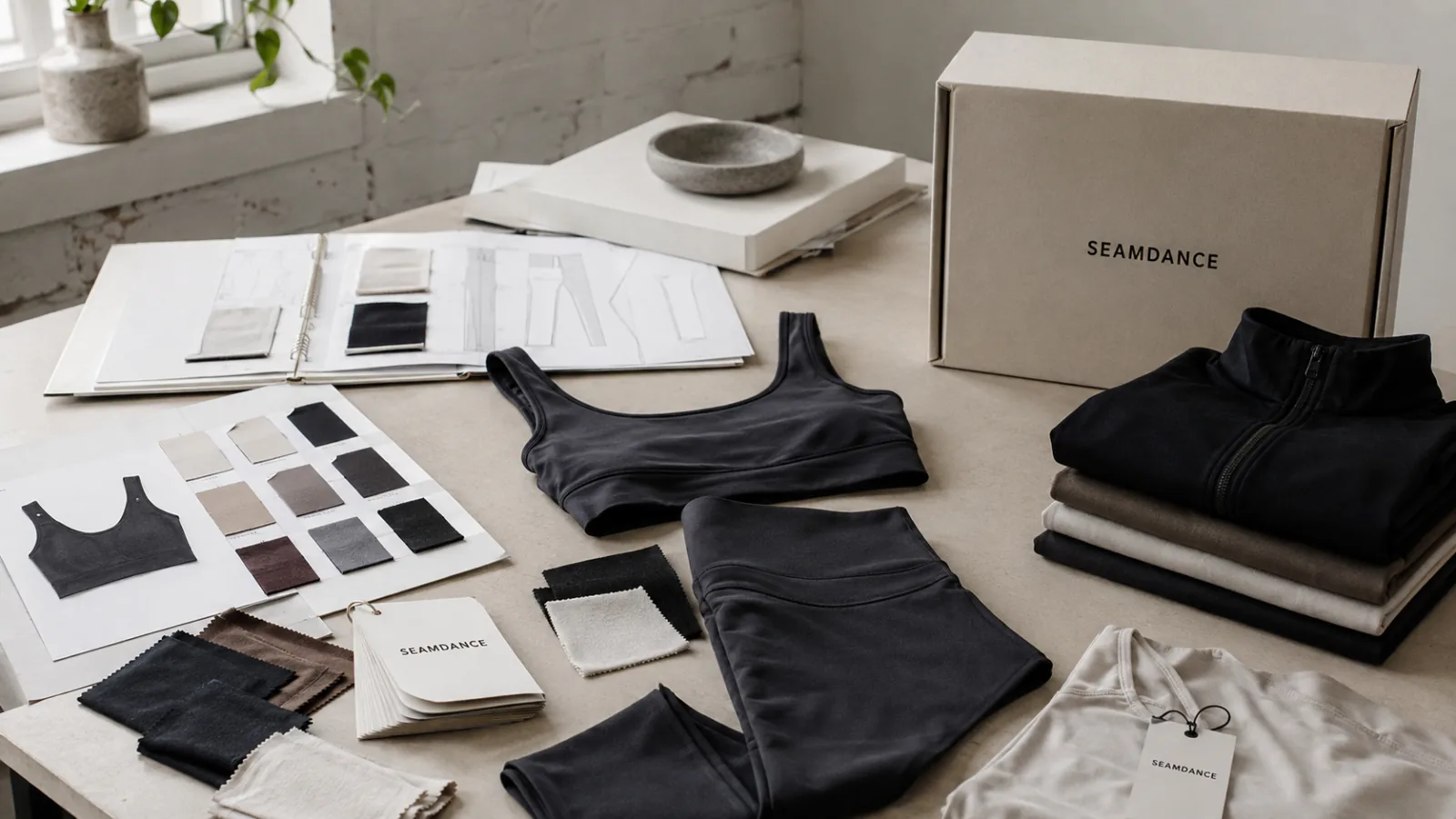
First collections fail in predictable ways: too many styles, too many colors, sizing guesses, and a calendar written backward from a dream date. The fix is sequencing. Here is the staged checklist we watch successful launches follow.
Stage one: decisions before any supplier
Define the customer and the use case narrowly enough to argue about — 'studio yoga, premium feel, sizes XS–XL, $80–95 retail' is a brief; 'women who work out' is not. Set the range plan small: a strong first collection is commonly one hero legging, one bra, one top in a coherent palette — roughly three to five styles, two to four colorways.
Reverse-engineer the money: retail price, channel margins, target landed cost. That math — not ambition — decides fabric tier, construction budget and whether custom development or a stock program starts the story.
Stage two: choose the development route
Stock programs (from 100 pieces at SEAMDANCE, mixed sizes and colors) put real product in your hands fast with your branding — the smart market test. Custom development (normally 300–500 pieces per style) buys your own fit, fabric and details — the defensible product. Many strong launches combine them: stock basics for volume, one custom hero style for identity.
Whichever route, insist on the disciplines the rest of this library covers: written specs, staged approvals, a sealed reference before bulk, AQL 2.5 final inspection. First-time buyers get the same physics as veterans.
Stage three: the honest calendar and budget
A realistic first-run calendar: brief and quotation (days — quotations return within 24 hours at SEAMDANCE), sampling and fit (two to five weeks depending on custom depth), bulk production (four to eight weeks), freight (one to six weeks by mode and lane). Roughly three to five months brief-to-warehouse for custom; stock programs compress dramatically.
Budget beyond the goods: samples, testing, freight and duties (the landed-cost multiplier), photography, packaging, and a reserve for the reorder you hope to need. Founders who budget only the production invoice launch strong and then starve their own restock.
Stage four: launch stock and the day after
Buy launch stock to survive being right: if the hero sells out in week two and the reorder takes ten weeks, the algorithm and the audience both cool. Size-curve your buy from your size chart's reality, not Instagram's — mid sizes dominate actual sales.
Instrument everything from day one: returns by reason, size exchange patterns, sell-through by color. That data is your second collection's brief — and the difference between a launch and a brand.
Quick answers
How much does a first collection cost all-in?
Ranges vary wildly by route, but the structure is stable: goods (quantity × landed unit cost) plus roughly 20–40% again across samples, testing, freight, duty, packaging and content. Model it per style before committing — we quote the goods side within 24 hours so the model has real numbers.
Should I launch with custom or stock product?
If your story depends on a unique product, custom the hero and stock the rest. If your story is brand and community, stock programs from 100 pieces validate demand before you spend custom-development money.
Sourcing styles for your line? The 2026 catalogue lists every ready-to-develop style — colorways, materials, quote list built in.