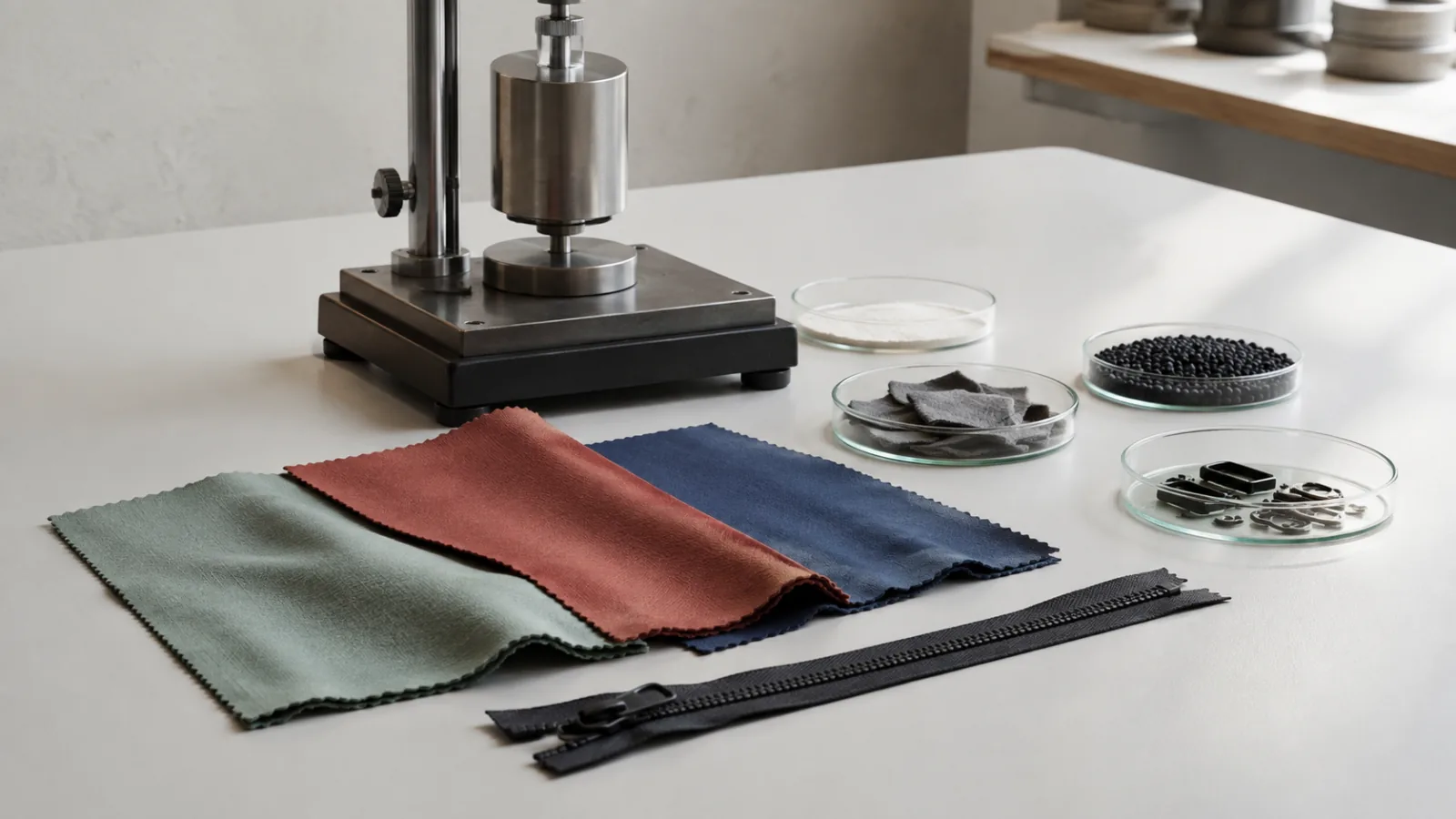
Most brands budget for compliance testing the way they budget for a courier: one line, one number. Then the quotation arrives priced per material, per colour and per part, and the number they wrote down turns out to be a single cell in a multiplication table. This is that arithmetic worked out loud on one style — and an honest account of which multipliers you can remove and which you cannot.
The short answer
- There is no per-style price for laboratory testing. Labs price per test article, and a different fabric, a different colourway and a different component are each a separate article.
- Worked on indicative published ranges, one activewear style in three colourways with a contrast zip lands somewhere around US$540 to US$1,950 — a planning band, not a quotation, and not a price we set.
- Across a 300-unit first order that is roughly $1.80 to $6.50 a garment, which on a first run can be more than the margin the garment earns.
- The avoidable cost sits in colour count, standardised trims and reusable component reports. The unavoidable cost is anything a marketplace demands before it lets you list, and anything tied to a claim in your marketing copy.
There is no price. There is a formula.
Every brand asks the same question first — what does testing cost — and an honest answer has to begin by refusing it. Laboratories do not price a style. They price a test article: a specific material, in a specific colour, tested by a specific method. One compliance-guidance publisher states the mechanic in a single sentence: "lab testing costs increase for every material type, color, and part." That sentence is the entire cost model; everything below is arithmetic performed on it.
The figures here are indicative published ranges from that publisher's pages, updated between August and October 2025. Treat them as planning orders of magnitude, not as prices: chemical and heavy-metal testing on fabric at roughly $80–250 per fabric and per colour; the same on zippers and hardware at roughly $50–200 per part; fabric flammability at roughly $50–200 per fabric; physical and mechanical testing at roughly $200–800 per item. SEAMDANCE does not run a laboratory and does not set laboratory prices. Take quotes in your own name, from the labs you would use.
The spread inside each line is the useful signal. Scope drives it: which market's rules, which analyte list, which age grade, whether the lab runs a screen or a full panel. Two brands can be quoted at opposite ends of the same range for what looks like the same garment. An average price is therefore useless to you. A formula is not.
Before the arithmetic, it helps to see which of these costs are obligations and which are choices. In the United States, clothing textiles fall under the Standard for the Flammability of Clothing Textiles [1], fibre content must be disclosed using the established generic names [2], and a reasonable basis for the care instructions must be held before the item is sold [3]; in Europe the five care symbols are licensed trademarks recognised by ISO 3758 [4]. Those are not optional. A STANDARD 100 certificate, by contrast, is a voluntary certification of an article, issued for one year [6], and a recycled or organic claim is voluntary until you print it, at which point the chain has to be certified [8] [9].
One style, three colourways, one contrast zip
Take a style you recognise: a legging, one main fabric, three colourways, a contrast zip on a back pocket. Before counting money, count test articles. The main fabric in three colours is three articles for chemical testing, not one. The zip is a component in its own right. Flammability attaches to the fabric, physical and mechanical testing to the finished garment. That inventory is already longer than the single line on most cost sheets.
Now the arithmetic, on the indicative published ranges above. Fabric chemical and heavy-metal testing across three colourways: three articles at $80–250 each is $240–750. The zip and its hardware as one part: $50–200. Flammability on the fabric: $50–200. Physical and mechanical testing on the garment: $200–800. Add the low ends and you get $540. Add the high ends and you get $1,950. One style, three colours, one zip.
Two other published views land in the same place. The same publisher's observation of its own customers is that "most of our customers pay somewhere between 500 and 1800 USD per product." Marketplace-oriented ranges published in September 2025 put simple items at $350–500 per SKU, mid-range items at $800–1,200 and complex items at $1,500 and above. Three published perspectives converge: a single small-run style is a high-three-figure to low-four-figure exercise, not a two-hundred-dollar one.
Notice how easily it grows. A contrast panel is a second fabric carrying its own colours. A printed version is another article. Match the zip tape to each colourway and one $50–200 line becomes three. The example above is deliberately the modest version of a real range, and it still doubles on two merchandising decisions nobody thinks of as compliance decisions.
What counts as a separate test article
| Change to the product | New test article? | Why |
|---|---|---|
| Same fabric, second colourway | Yes | The dye is a chemical input; the panels screen for risks that sit in the colour rather than the cloth |
| Same colour, second fabric (contrast panel) | Yes | A different construction and often a different mill |
| A print added to an existing colourway | Yes | Print pastes and pigments are their own chemistry |
| A zip, drawcord or elastic in a new colour | Yes | Components are tested as components, not as part of the garment |
| Same article, second size | No | Size does not change the material |
| Same article, a second season | Depends | A STANDARD 100 certificate runs one year [6]; a lapsed certificate is a new submission |
Now divide it by the order
Custom programs at SEAMDANCE start at 300–500 units per style, so take 300 as the divisor. The $540 low end across 300 units is $1.80 a garment. The $1,950 high end is $6.50 a garment. That is a real line in your first-order cost, and it belongs beside fabric, trim and freight on the cost sheet — precisely where it is usually missing.
The uncomfortable part: on a first order that per-unit figure can be larger than the margin the garment earns. Whatever your gross margin per unit is on a 300-piece run, subtract $1.80 to $6.50 before you call it margin. One seller-reported figure makes the shape visible — treat it as an anecdote, not as data: a seller of a children's costume making roughly $10 profit per item was quoted $1,100–$2,600 by testing laboratories. At $10 a unit, that is 110 to 260 garments sold purely to get back to zero on testing.
The divisor is the only term you control after the fact. That same $1,950 across 300 units is $6.50; across 1,000 it is $1.95; across 3,000 it is $0.65. Testing is a fixed cost wearing the costume of a variable one — it does not scale with your order, so a small first run carries the whole burden. That is not an argument for over-ordering. It is an argument for knowing the number before you commit to a colour count.
There is a calendar cost on top of the cash cost. Laboratory turnaround was published in September 2025 at two to six weeks — not something you absorb at the end of a development calendar, but most of a production window. Testing that starts after bulk fabric is knitted costs a launch date as well as a fee, and the date is usually the more expensive of the two.
Why a colour is a different test
This is the multiplier brands find hardest to believe, and the one most discover after budgeting for a single test. A dye is a chemical input. The base cloth may be identical across your three colourways, but what has been put into it is not: different dyestuffs, different auxiliaries, sometimes a different dye house altogether. A chemical or heavy-metal test asks what is present in this material as presented to the lab. Change the dye and you have changed the answer, so you have changed the test article.
It is not a billing convention invented to sell more tests. The risks these panels screen for cluster in the colour rather than the cloth: some pigments carry metals, some deep and bright shades carry restricted amine chemistry, and the darkest shades carry the most dyestuff per gram of fabric. A clean result on a heather grey tells a regulator, a marketplace or a retail buyer nothing about your black or your bright coral.
So colour count is a compliance decision as much as a merchandising one, taken months before anyone speaks to a laboratory. Five launch colours is not five times the sales opportunity of two — but it is reliably five-thirds the fabric chemical bill of three, on top of five sets of lab dips and five fabric minimums. Prints and contrast panels behave identically. Count the test articles when the range plan is signed off, not when the quotation arrives.
PFAS: the number nobody publishes
We went looking for credible published 2026 pricing for apparel PFAS and total-organic-fluorine testing and could not find any. The major laboratories do not publish it. What circulates in sourcing groups is either a single anonymised quote with no scope attached, a figure lifted from a different matrix such as water or food packaging, or a number with no method named. We are not going to invent one to make this article look complete. Anyone who hands you a confident single figure without naming a method and a scope is guessing with your budget.
Get your own quotes, and make them comparable before you compare them. Specify four things: which market and which requirement you are testing against; whether you want a total-fluorine or total-organic-fluorine screen or a targeted analyte list, and how many analytes; which materials are in scope — face fabric, coating or finish, trims — and whether the price is per material or per material per colour; and what happens if a screen comes back above threshold, because the follow-up work is often where the real cost lives. Quotations differing by an order of magnitude almost always differ on those points, not on laboratory quality.
The uncertainty is itself the finding. This area moves faster than anybody's published price list, which is why a number in a blog post would be the least reliable thing to plan against. What a brand needs is a named contact at a laboratory, a scope agreed in writing, and a re-quote whenever the requirement or the range changes. Being straight that the figure is unpublished beats a plausible-looking one you would build a cost sheet on.
What you can genuinely cut — and what you cannot
Four levers reduce the bill, and all work by removing test articles, not by negotiating a rate. Cut the launch colour count until sell-through is proven: two colours now and a third on the repeat removes an article this season and adds it back cheaply later. Standardise trims so one zip, one cord and one label serve six styles and are tested once. Test at component level and keep the reports, so a qualified component is inherited by every style using it. And sequence — test what the market you are shipping to requires now, not everything you might need later.
Two categories are where saving money is false economy. The first is anything a marketplace or retailer will demand before it lets you list. Four hundred dollars saved against a listing that never goes live is not a saving; it is stock sitting in a warehouse behind a compliance hold. Every large platform publishes its requirement, none negotiate it, and the cheapest moment to read it is before production.
The second is anything tied to a claim in your own marketing copy. If your product page states a fibre content, a chemical property, a safety property or a named standard, you have to be able to hold the document that supports it. The claim costs nothing to type and a great deal to defend, which makes it so common and so avoidable. If you are not going to pay for the test, delete the sentence — close to the only free decision in this article.
Not a lever: picking the laboratory with the smallest number. Two quotations only compare when the analyte list, standard revision and article count are identical. A cheaper quote is usually a narrower one, and the gap reappears as a retest at a worse point in the calendar.
Reusing an existing report, and when the maths says wait
Reuse of a partner facility's existing report is the most under-asked lever and the most over-promised one. Sometimes it is genuinely available — a mill or trim supplier tested the same material to the same standard recently. Ask early: it costs nothing, and a usable report removes a whole line from the budget.
It also fails more often than buyers expect, in four predictable ways. Scope: the facility tested to what a different customer asked for, rarely your list. Revision: the standard has moved and the report is against the previous version. Party: the report was issued to another company, and a document in someone else's name may not be one you can rely on or present. Material change: a new dye lot, colourway or trim supplier means the article tested is not the article you are buying.
And ask for the full report, not the one-page summary or certificate. A summary tells you a result. The report tells you what was tested, by which method, to which revision, on what date and for whom — only that lets you judge whether it covers your product or somebody else's.
Sometimes the arithmetic simply says wait. If a style needs three colourways, a contrast fabric and two hardware components to work as a concept, its testing bill can approach or exceed the gross margin on a 300-unit first run — and no supplier negotiation fixes that, because the money is not going to the supplier. The honest options: launch it in one colour, simplify it until the test-article count falls, move it behind a style that is cheaper to qualify, or shelve it until volume justifies the fixed cost. Running this arithmetic and choosing to wait beats running it after the fabric is knitted.
Where SEAMDANCE fits is narrow and worth stating plainly. Working across a program rather than a single style, we can consolidate testing so one component report serves several styles. We can put a partner facility's existing reports and their actual scope in front of a brand before it pays for new ones, so the reuse question is settled by a document rather than a promise. And we can time testing so it runs alongside sampling instead of sitting on the critical path. What we do not do: we do not run a laboratory, we do not set laboratory prices, and we do not certify compliance. The report is issued by the lab, in your name, and responsibility for the claims stays with you.
This is general information, not legal advice. What you are required to test, and what it costs, depends on the markets you sell into, the product itself and the channels you sell through — take your own quotations and your own advice against your own range.
What genuinely reduces the bill, and what does not
| Lever | How it works | Limit |
|---|---|---|
| Fewer launch colourways | Removes whole test articles, which is the only thing that moves the number | Merchandising decision, taken months before the laboratory is contacted |
| One fabric across several styles | One article covers more of the range | Only if it is genuinely the same fabric from the same mill |
| Standardised trims across the range | A zip tested once serves every style using it | Colour-matched trims reintroduce articles per colourway |
| Reusing supplier component reports | A component already tested may not need retesting | The report must name the component and be in date; check the holder |
| Building on an already certified fabric platform | Avoids bringing a new article into scope [6] [7] | Restricts fabric choice |
| Negotiating the laboratory's rate | Marginal | Labs price per article; the article count is what you control |
| Skipping what a market requires | Not a lever | Flammability [1], fibre content [2] and care basis [3] are obligations, not line items |
Quick answers
Why does a second colour cost as much as a second fabric?
Because the laboratory prices per test article, and a dye is a chemical input. The base cloth may be identical, but the substances the panel screens for often sit in the colour rather than the cloth, so each colourway is submitted and analysed separately.
Which of these tests am I legally required to do?
That depends on your market and your product, and this is general information rather than legal advice. In the United States, clothing textiles are covered by the flammability standard [1], fibre content must use the established generic names [2], and you must hold a reasonable basis for the care instructions before sale [3]. In Europe, the care symbols are licensed trademarks [4]. Certifications such as STANDARD 100 [6] or a recycled claim [8] are voluntary until you make the claim.
Can I reuse my mill's test report instead of paying for my own?
Sometimes, and it is the cheapest legitimate saving available. The report has to name the article you are actually buying, be in date, and be held by a party in your chain. A certificate covering a mill's fabric does not cover your trims, your print or your sewing.
How far ahead should testing sit in the calendar?
Ahead of bulk fabric commitment, not after it. Laboratory turnaround is measured in weeks rather than days, and a failed result after the fabric is knitted and dyed turns a testing cost into an inventory write-off.
Sources
- 16 CFR Part 1610 — Standard for the Flammability of Clothing Textiles (eCFR)
- 16 CFR Part 303 — Rules and Regulations Under the Textile Fiber Products Identification Act (eCFR)
- 16 CFR Part 423 — Care Labeling of Textile Wearing Apparel and Certain Piece Goods (eCFR)
- GINETEX — Care labelling: the five symbols, ISO 3758 and the trademark licence
- AATCC — Testing & Standards: test methods for textile evaluation
- OEKO-TEX® STANDARD 100 — what is certified, the four product classes and the one-year certificate
- OEKO-TEX® ECO PASSPORT — chemicals, colourants and auxiliaries tested against the standard's criteria
- Textile Exchange — Global Recycled Standard and Recycled Claim Standard: content thresholds and requirements
- Textile Exchange — Organic Content Standard (OCS)
Sourcing styles for your line? The 2026 catalogue lists every ready-to-develop style — colorways, materials, quote list built in.